01
Classify stations by what they disturb and what can disturb them
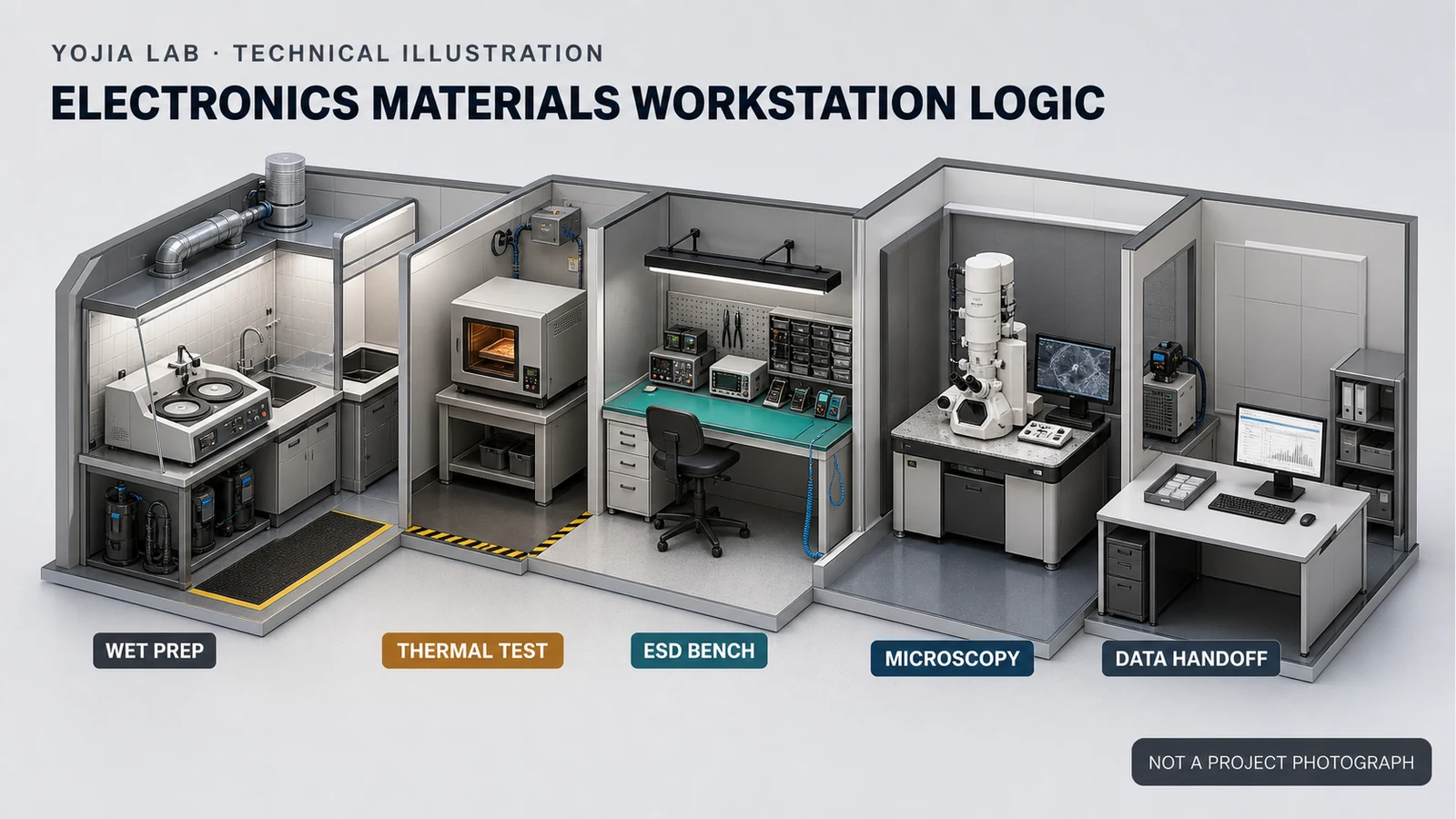
Begin with two questions for every operation: what energy, contamination, or hazard does it release, and what environmental change could invalidate its result? Sectioning, grinding, polishing, sonication, pumps, ovens, and carts may create vibration, particles, heat, noise, or vapour. Electrical measurements, optical inspection, dimensional metrology, and electron microscopy may instead be vulnerable to motion, electromagnetic fields, temperature drift, airflow, or contamination. Record both directions in a station matrix before deciding whether a position is a bench, enclosure, independent frame, supplier stand, instrument plinth, or desk.
Give each proposed support a clear duty rather than a broad label such as heavy-duty or anti-vibration. The equipment record should identify mass, point loads, centre of gravity, moving loads, support locations, operator posture, service panels, loading path, and maintenance envelope. The room record should hold the criteria that furniture cannot provide, including structural capacity, floor response, environmental stability, and electrical or ventilation conditions. This division prevents a reinforced cabinet from being sold as a substitute for a verified instrument site and keeps unresolved supplier inputs visible through procurement.
02
Keep abrasive, wet, and thermal preparation on deliberate work lines
Build preparation furniture around the actual sample sequence. A cross-sectioning route may need a receiving tray, clamping or cutting position, debris capture, grinding and polishing, ultrasonic or solvent cleaning, drying, inspection, and a protected handoff. Place consumables, residues, spent media, and waste where staff can change status without crossing the clean measurement surface. When acids, solvents, engineered particles, hot work, or other hazards are present, the risk assessment and approved engineering control define whether the task belongs in a chemical hood, a local enclosure, or another controlled device; a splash-resistant worktop alone is not exposure control.
Choose the complete assembly from the exposure matrix. OSHA's laboratory recommendations describe wet-chemical surfaces as chemically resistant, smooth, and easy to clean, and call for local exhaust appropriate to the material and operation. Translate that planning principle into verified worktop and liner data, sealed or replaceable joints, compatible sink and edge details, access to traps and ducts, and sacrificial panels where abrasion is expected. Separate heat-producing equipment from vulnerable finishes and storage, show safe loading and cooling clearances, and make damaged components replaceable without dismantling the adjacent precision work area.
03
Give precision instruments a stable envelope, not a decorative bench
Use the instrument manufacturer's current site requirements and a measured room survey to define precision positions. JEOL notes that floor vibration can reduce analytical-instrument performance and that isolation must be tuned to the actual installation site. LBNL's electron-microscopy laboratory study similarly identifies vibration, acoustic energy, stray magnetic fields, temperature variation, airflow, grounding, and ancillary-equipment heat as interacting environmental factors. These examples do not create a universal microscopy specification; they show why the workstation drawing must reference a model-specific environmental schedule and a named acceptance method.
Decide explicitly what touches the building and what touches the furniture. A microscope, surface profiler, balance, or probe station may need its supplier stand, an independent table, a structural plinth, isolation, or a separate instrument room, while monitors, controls, small tools, and documentation can use adjacent casework. Keep pumps, chillers, transformers, compressors, rolling storage, and busy circulation outside the sensitive envelope where the verified criteria require it. Route power, signal, cooling, and exhaust so cables or hoses do not bridge an isolation joint, obstruct access, or transmit avoidable disturbance back to the instrument.
04
Treat an ESD bench as one component of a local control plan
First identify which samples, devices, assemblies, or instruments are electrostatic-discharge sensitive and what approved control programme applies. NASA's workmanship guidance explains that ESD controls are site-specific and connect workspace materials and practices with training; its public handbook is guidance for limiting ESD damage, not a certificate for a furniture product. The responsible electronics, quality, safety, and facility teams must therefore define protected-area boundaries, grounding architecture, personnel controls, flooring, seating, packaging, tools, humidity considerations, monitoring, test methods, records, and response to a failed check before furniture details are frozen.
Furniture drawings can then implement their assigned part: the approved worksurface construction, accessible common-point connection, bonding provisions where specified, cable separation, equipment earth interfaces, monitor position, leg clearance, task lighting, and storage that preserves protected packaging. Avoid isolated claims such as ESD-safe bench when the floor, chair, operator, tools, grounding, verification, and maintenance are outside the supplier's scope. Commission the complete station with the organisation's accepted instruments and procedures, label responsibility boundaries, and retain readings or inspection records according to the local control plan.
05
Approve furniture by representative work, service, and change scenarios
Review a dimensioned mock-up or first article for each distinct station class rather than approving finishes from a small sample. Walk a rough specimen through preparation and cleanup, load a thermal device, perform a seated electrical test, transfer a protected sample, exchange a microscope holder, reach every isolation point, and simulate calibration and service. Check glare, posture, knee space, label visibility, tool reach, cart approach, cable bend radius, door and drawer conflicts, cleaning access, spill boundaries, equipment removal, and emergency equipment clearance. Record exceptions as project decisions rather than correcting them informally during installation.
Handover should link every station to its equipment record, exposure matrix, ESD responsibility, environmental criterion, approved surface, utility points, load basis, service route, inspection task, and replacement plan. Trigger a review when a new sample chemistry, heavier instrument, different microscope, higher-temperature process, revised ESD-sensitive item, or changed test method arrives. Stanford's laboratory design guide frames safety and flexibility as coordinated design objectives; apply that principle by making future change visible and reviewable, not by putting every unit on castors or claiming that one modular system can accept unknown work without reassessment.