01
The pour is a short open job
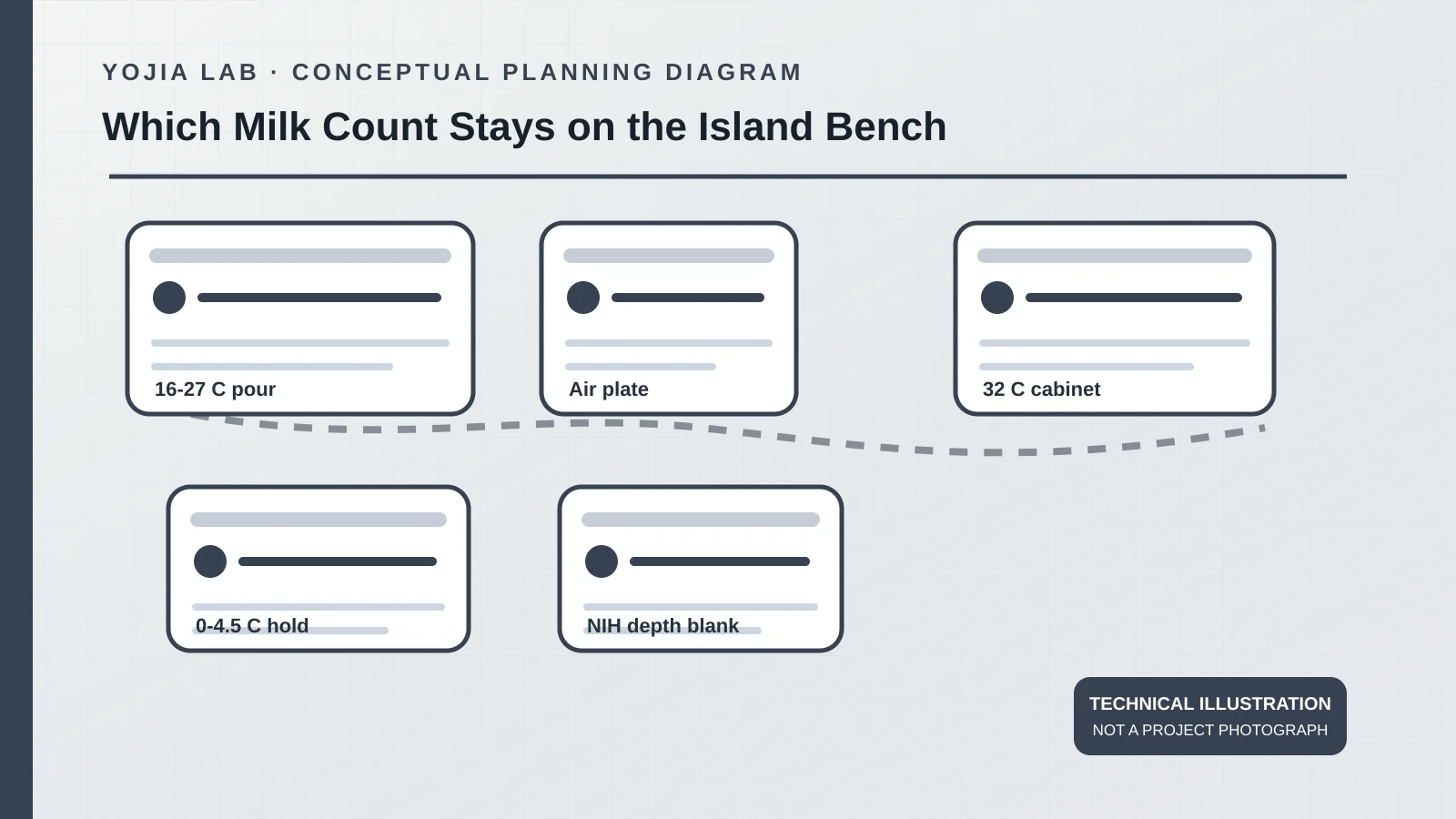
Item 3 of the March 2024 pour-plate form asks for a level plating bench out of direct sunlight, sanitized before the pour. The air-control plate is poured first, before the shake, with the cover off for 15 minutes and the plate kept in the plating area. After incubation it shall contain fewer than 15 colonies, and a count above 15 needs a recorded correction. The series finishes within 20 minutes of the first dilution; 10 minutes or less is marked preferred. Take the portion within 3 minutes of 25 shakes in 7 seconds through about one foot. A pipet stops 2.5 cm below the surface.
Melted agar stays at 45±1 °C and is discarded if unused three hours after tempering. Pour 10–12 mL, or 12–15 mL when the portion exceeds 1 mL or a documented weight problem requires it. Plates set within 10 minutes and are not stacked before that. Then invert them, no more than six high, and incubate within 10 minutes with air around the stacks. Standard plates stay at 32±1 °C for 48±3 hours, dry milk for 72±3 hours, and coliform plates for 24±2 hours. The form’s example, 244 colonies at 1:100 and 28 at 1:1000, computes 24,727 and is shown reported as 25,000. That example is not a bench size.
02
The room band is not the incubator set-point
The October 2019 cultural form scores a level bench, clean and ventilated, at 16–27 °C. Light is more than 50 foot-candles, with 100 preferred. Its air limit is not more than 15 colonies on a standard or rapid aerobic plate during 15 minutes. The March 2024 form instead says fewer than 15 after incubation and names action above 15. Copy the sentence the survey will use. Only compatible work is allowed, and eating, drinking, and storing food or drink are forbidden.
The incubator is not crowded, and shelves are placed for an even temperature. Morning and afternoon readings come from two sensors held in liquid, on an upper shelf in use and a lower one. Agar poured at 10–12 mL must not lose more than 15 percent of its weight in 48 hours. The sample refrigerator is separate: 0.0–4.5 °C, for milk, media, and reagents only, and an out-of-range sample is marked not analyzed. The freezer holds −15 °C or below. A thermometer used from 0 to 100 °C is graduated at 0.5 °C or finer and checked to ±1 °C at the use temperature before first use and yearly.
03
Put the island only where the pour happens
An island laboratory bench, where the room uses one, is only the open pour: the air plate in the activity, the dilutions, and the 10-minute set, in the 16–27 °C room. A shelf of plates that have not set breaks the stacking line. An air plate on a side counter breaks the placement line. Media preparation and a direct microscopic somatic-cell count are other jobs. The cultural form asks for a functioning fume hood with an acceptable sash only when that count needs one. Neither milk form prints a face velocity.
If counting waits, the March 2024 form allows 0.0–4.5 °C for not longer than 24 hours and says not to make the delay routine. The open bench is not that refrigerator. The pour needs a sanitizable level top, light above 50 foot-candles, and clear space for the air plate. A mechanical shaker is allowed only when this laboratory holds validation data for that unit. A socket for the shaker does not show that two analysts fit at the top.
04
Leave the NIH depth in the NIH column
Section 2.2.2.1 sets a 3.4 m (11 ft) module for new NIH laboratory construction unless stakeholders accept another. The width it calls optimum is a 1.5 m (5 ft) aisle plus 762–914 mm of bench or equipment on each side. Section 4.5.3.1 recommends 762 mm at walls and 1.5 m at peninsulas and islands, a 25 mm overhang with a drip groove, grommets on 762 mm benches but not on 914 mm benches, and splash guards at least 305 mm where a high bench meets a low one. Cup sinks stay out of benches unless the program requires them.
The milk forms never print 1.5 m, 762 mm, or 914 mm. Writing that depth onto a milk-lab order invents a tolerance the survey does not grade. On an NIH building the exception path is the manual’s stakeholder rationale. Elsewhere, 1.5 m is used only when a written decision says so. Until then the island laboratory bench follows the pour: level, out of sunlight, room at 16–27 °C, air plate in the activity, and the 32±1 °C cabinet somewhere else. A sketch of one island and one incubator is not a measured installation and does not name a material.
Before pricing, place the room dimensions, user sides, and service interfaces for the island laboratory benches with the workflow notes above. The final configuration remains the approved quotation and drawings.