01
The market file does not locate an enclosure
Article 8(1) of Regulation (EC) No 1223/2009 requires cosmetic manufacture to follow good manufacturing practice for the aims in Article 1. Article 8(2) presumes that practice where manufacture follows harmonised standards published in the Official Journal. Article 10 requires an Annex I safety report before the product is placed on the EU market. Article 12 expects reliable, reproducible sampling and analysis. None of those articles names a sash, an exhaust rate, or a hood count.
FDA’s June 2013 draft, Cosmetic Good Manufacturing Practices, says it records the agency’s thinking, does not bind FDA or the public, and allows another approach if statutes and regulations are met. Buildings should have adequate lighting and ventilation and, where control needs them, screening, filtering, and controls for dust, humidity, temperature, and bacteria. Laboratory controls should examine raw materials, including water, in-process material, and finished product for identity, physical and chemical properties, microbes, and chemical contamination, on a sample that represents the lot. That is a quality system. It does not place a fume hood.
02
One protocol names the opening twice
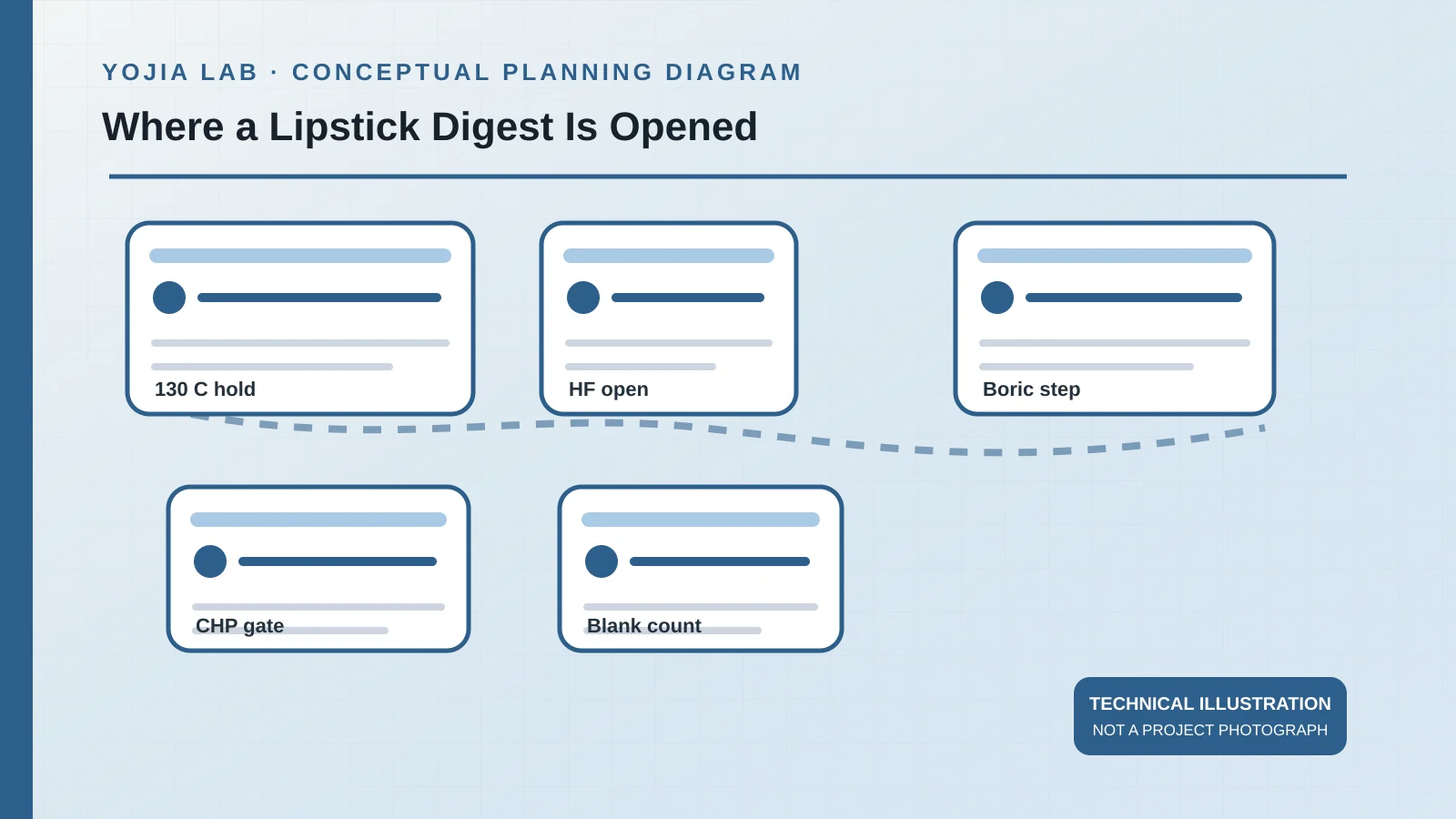
A May/June 2012 protocol in the Journal of Cosmetic Science, used on 400 lipsticks, says it follows FDA’s validated lead method. Weigh 0.3 ± 0.1 g, add 7 ml of nitric acid and 2 ml of hydrofluoric acid, seal, and microwave: 20 minutes to 130 °C, hold 3 minutes, then 20 minutes to 200 °C, hold 30 minutes, then cool below 50 °C. Vent and open in a fume exhaust hood. Add 30 ml of 4 percent boric acid, reseal, ramp 20 minutes to 170 °C, hold 10 minutes, cool, and open again in a fume exhaust hood. Dilute to 50 ± 0.25 ml. Curves in that write-up exceeded a correlation of 0.997, and quality-control recovery sat between 90 and 110 percent.
Hepp, Mindak, and Cheng, in volume 60 (July/August 2009), estimated a detection limit of 0.04 μg of lead per gram. Twenty-two red-shade lipsticks ranged from 0.09 to 3.06 μg/g and averaged 1.07 μg/g. Fortified recovery with nitric acid plus hydrofluoric acid averaged 98.1 percent. Estuarine sediment SRM 1646a needed hydrofluoric acid and then boric acid; nitric acid alone recovered the other reference materials in that set. Three of five lots, plus a composite, read substantially higher with hydrofluoric acid. The authors called the shade range limited. Those figures belong to that method and that set. They do not rate an enclosure.
03
The U.S. laboratory rule is a plan with a gate
Where 29 CFR 1910.1450 applies, the employer’s written chemical hygiene plan must protect employees from the hazardous chemicals in that laboratory and keep exposures under paragraph (c). The plan must require that fume hoods and other protective equipment function properly, and it must state the checks. For particularly hazardous substances it must, where appropriate, include a designated area, containment such as fume hoods or glove boxes, waste removal, and decontamination. Review is at least annual. Appendix A is non-mandatory. It calls chemical hoods the main protection, points to Table 9.3 of the 2011 Prudent Practices, keeps vented-storage chemicals out of the hood, and bars evaporating waste there.
The section covers employers engaged in the laboratory use of hazardous chemicals. A laboratory here uses relatively small quantities on a non-production basis. Laboratory scale means one person can handle the containers safely, and it excludes workplaces that produce commercial quantities. The room is inside the rule only when all four conditions are met and OSHA covers the employer: laboratory scale, more than one chemical or procedure, work that is not production, and protective practices already in common use. Hydrofluoric acid is an acute health hazard under the criteria the section uses. This note does not classify any named factory.
04
What the utility sheet may record
Join the two papers only under a written assumption. The 2009 validation used batches of 12 vessels, including blanks and reference materials, not twelve sticks alone. The 2012 protocol opens vessels in a fume exhaust hood after the 200 °C hold and again after the 170 °C boric-acid hold. A planner who accepts both for one microwave should put the hood at that opening and write nitric acid, hydrofluoric acid, and the boric-acid addition on the same row, plus the two holds and the cool-below-50 °C step. The row cannot carry a face velocity. The mandatory text reviewed here prints none, and this note measured no hood.
Leave other cosmetics tasks off that row until their own method is attached. The FDA draft asks for microbial checks and for preservation under reasonable storage and use. Those tasks do not open a hydrofluoric-acid vessel. Retained units, a balance that sees only intact sticks, and a microbiology bench are different addresses. The non-mandatory appendix treats the hood as the wrong cupboard for chemicals that need their own vented cabinet, and as the wrong place to boil waste. If nobody has said whether 1910.1450 applies, the hood quantity stays blank.
Before pricing, place the room interface, quantities, and service points for the laboratory fume hood systems with the workflow notes above. Airflow, performance, and compliance stay with the project's responsible reviewers.