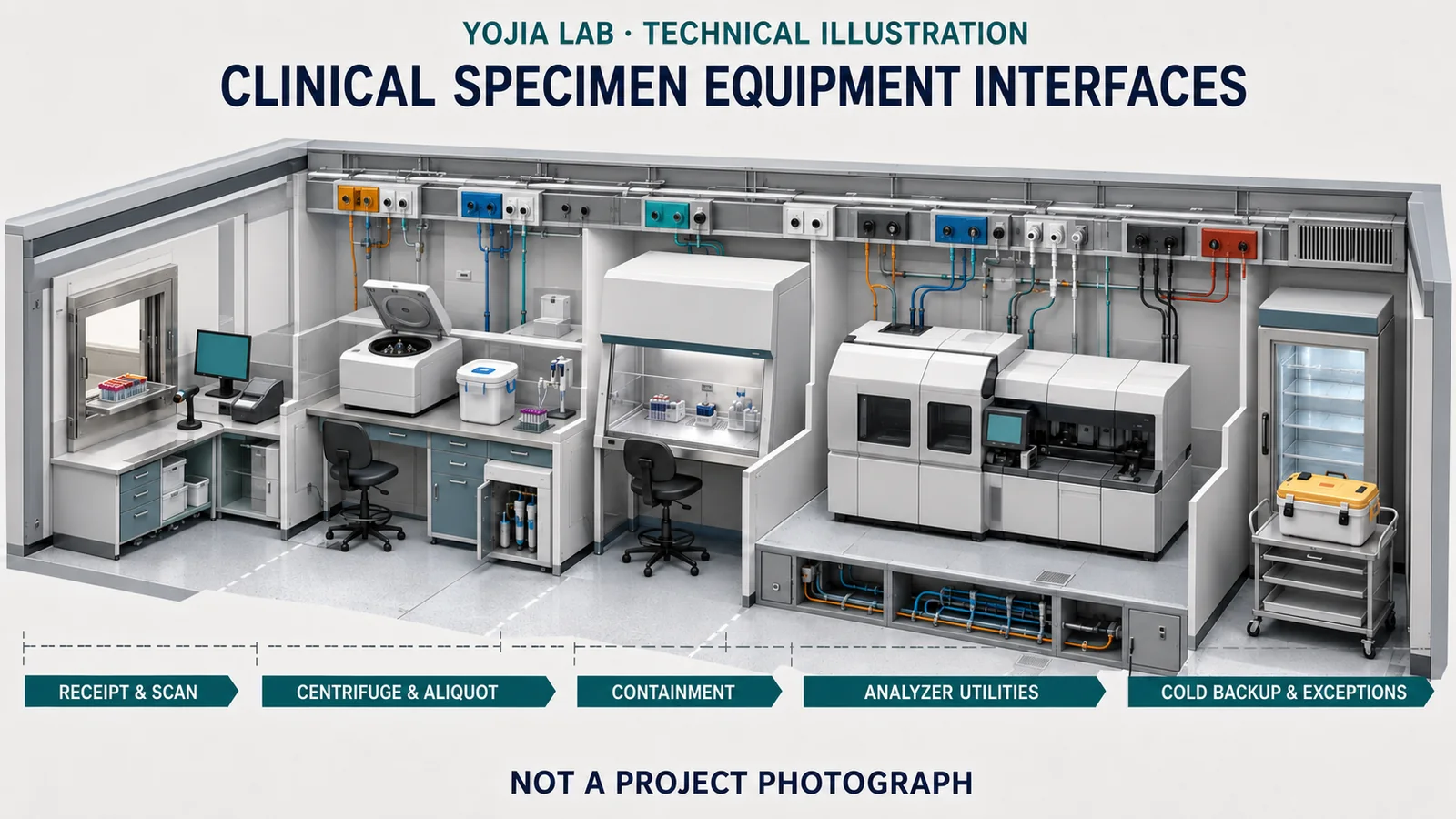
01
Start with specimen and equipment operating states
Draw the process from the laboratory handover point rather than from a furniture plan. For each specimen family, show the expected container, identity check, closed or opened state, temperature condition, next action, maximum internal queue target, responsible role, and the evidence needed to continue. Add separate routes for leaking, broken, unlabelled, delayed, restricted, insufficient, or unexpectedly hazardous material. CDC diagnostic-laboratory guidance treats receiving and setup as active safety work and recommends controls based on the task and risk. The design consequence is a real inspection and containment position, not simply a pass-through counter beside the door.
Place every equipment item on the same state map. A centrifuge is not one fixed box: staff load racks, open lids, transfer sealed carriers, clean chambers, recover a broken tube, remove rotors, and access the unit for maintenance. An automated analyzer may receive racks, load reagents, reject samples, discharge liquid or solid waste, produce heat, connect to middleware, and require technician access during faults. Mapping normal, cleaning, fault, service, and replacement states exposes conflicts that a list of model names will miss, including doors that collide, contaminated parts that cross clean work, and service panels blocked by casework.
02
Build a model-specific interface register before issuing service drawings
For each confirmed model and configuration, record footprint, height, mass, point loads, centre of gravity where relevant, bench or floor support, vibration sensitivity, ventilation clearance, heat output, ambient limits, power quality, connector type, water requirement, drain type and elevation, exhaust need, data link, noise, consumables, waste, and the clear space needed for users and service technicians. Use current manufacturer documentation and resolve conflicting revisions with the supplier in writing. The register should distinguish supplied components from building work and furniture work, because a shown connection point does not establish who provides the valve, isolation, hose, trap, regulator, outlet, or final testing.
Manufacturer data demonstrate why generic laboratory notes are inadequate. Beckman Coulter publishes a specific analyzer configuration with defined weight, dedicated electrical conditions, deionized-water criteria, a gravity-drain relationship, heat output, and environmental limits. Those values belong to that system, not to every clinical analyzer. The project method is to request equivalent current data for the exact purchased configuration, then coordinate routing, isolation, accessibility, leak response, and capacity with qualified engineers. Keep spare positions as documented future interfaces only when the laboratory has a credible expansion plan; unassigned outlets and drains can create maintenance and contamination liabilities.
03
Coordinate containment, airflow, surfaces, and maintenance as one decision
Containment selection must follow procedures and risk assessment. CDC/NIH BMBL 6 emphasizes protocol-driven assessment and is advisory rather than a universal regulatory prescription. CDC diagnostic guidance also identifies aerosols from centrifugation, tube opening, mixing, and other manipulations, and discusses sealed rotors, safety cups, and biological safety cabinets as possible controls. Translate the approved control strategy into location and interface requirements: cabinet certification access, safe sash or opening use, room-air interaction, nearby hand hygiene, carrier transfer, waste closure, and a route for decontamination or component removal. Do not label an open bench safe or require a cabinet solely from the room name.
Furniture and utilities must support the selected cleaning and spill response. Specify smooth, durable, accessible interfaces appropriate to the laboratory's agents and disinfectants, while keeping joints, cable bundles, wall gaps, and under-equipment spaces reachable. Separate handwashing from instrument water and waste; never infer that an analyzer drain may enter an ordinary sink or building line without a documented waste decision. The WHO design-and-maintenance monograph frames laboratory planning as a risk- and evidence-based collaboration across users, biosafety, architecture, engineering, construction, and maintenance. Apply that collaboration to every penetration, valve, access panel, sensor, and movable connection.
04
Design continuity around the whole service chain
Classify continuity by specimen and operational consequence, not by equipment price. For each device, ask what happens to specimens already loaded, what data are held locally, whether doors or probes can be safely released, how long temperature or process state remains acceptable, and what dependent services are needed for recovery. Emergency power to an analyzer may be ineffective if its room cooling, water system, waste handling, network switch, middleware, barcode printing, refrigerator, or decision-making staff are unavailable. Document the permitted interruption, shutdown sequence, restart evidence, backlog capacity, and authority to divert or reject work without inventing universal recovery times.
Provide a verified exception route before commissioning. A backup centrifuge must accept the required carriers and workload; a reserve cold unit must have monitored capacity and controlled access; an alternative analyzer may need compatible methods, reagents, interfaces, quality controls, and authorization. Include blocked drainage, water-quality excursions, alarm communication failure, network downtime, and contaminated maintenance work, not only loss of electricity. WHO's laboratory quality-management handbook treats equipment, information, occurrence management, documents, process control, and sample management as connected quality-system elements. The spatial and utility plan should make those operational connections possible rather than assuming procedures can overcome a missing interface.
05
Commission interfaces with representative loads and failures
Before equipment delivery, verify openings, turning paths, lift capacity, floor and bench levels, isolation labels, outlet and connection locations, access clearances, data readiness, drain falls where applicable, and the removal route for future replacement. At startup, separate building-service tests from vendor installation, laboratory method verification, containment certification, and organizational approval. Use representative racks, carriers, consumables, waste containers, and maintenance tools to test loading, scanning, reach, cleaning, cable movement, lid or door travel, heat clearance, and staff circulation. Record defects and ownership instead of accepting an interface because the equipment powers on.
Challenge the operating system with realistic events: a leaking arrival, broken tube in a sealed carrier, centrifuge imbalance, analyzer stop with samples onboard, full waste container, water or drainage alarm, network loss, cold-storage alarm, utility interruption, after-hours callout, and unavailable backup position. Confirm who detects the event, who makes the specimen decision, what must be documented, and how work resumes. Then place the equipment-interface register under change control. A new assay, tube, rack, instrument module, disinfectant, middleware version, workload pattern, or service contract can alter utilities, heat, containment, access, and downtime assumptions long after handover.