01
Tie the hood line to the hygiene plan
OSHA's laboratory standard, 29 CFR 1910.1450, requires a written chemical hygiene plan where hazardous chemicals are used. The plan must require that fume hoods and other protective equipment function properly, and it must name the measures used to check that performance. A line that only says chemical hood does not do this. Ask which operations need containment, which chemicals are routine, and which procedures need approval before they start. If the answer is still a guess, leave the cell blank and name an owner.
The National Academies' Prudent Practices treats a laboratory chemical hood as a device for toxic, offensive, or flammable material formed during a procedure. It is a poor place to store bottles, and it should not be used to evaporate waste solvent. Check each hood before first use and at least yearly, against the face-velocity criteria already written in the hygiene plan or the ventilation plan. A continuous monitor should be read each time the hood is used. Put the monitor and the yearly check on the hood line. The base can wait.
02
Draw the sash, the baffles, and the setback
OSHA's chemical fume hood quick facts describe use, not a brand. Keep the sash at the marked operating level and keep the user's head out of the opening plane. Leave baffles and exhaust slots clear. Raise large equipment at least two inches off the interior base, and keep materials at least six inches back from the sash. Close the sash when nobody is working, and do not store chemicals inside. Tag a hood that is not working and keep it out of service until it is repaired.
Turn those use rules into a note before the base is ordered. Show the marked sash height, the six-inch setback, and any lattice that leaves the baffles open. Princeton's laboratory design appendix prefers a single vertical sash, a recessed work surface, and a location away from doors and away from a second hood across a narrow aisle. Ask whether this room has the same conflicts. Do not copy that campus note as a universal dimension.
03
Place valves, cupsinks, and power where hands can reach them
The same Princeton appendix places utility shutoffs outside the laboratory, asks for enough outlets to avoid extension cords, and calls for ground-fault protection near sinks. It warns against extra cupsinks, because an unused trap can dry out. A hose bib meant to take a hose needs backflow prevention. None of that text picks a fixture brand. It leaves three questions open: which services enter the hood, which valve is remote, and which cupsink will actually be used.
Give cold water, vacuum, inert gas, and any fuel gas its own line. Fuel gas belongs on the sheet only after the hygiene officer allows it. Name the valve position, the handle side relative to the sash, and the shutoff outside the room. Do not bury that shutoff behind a fixed panel. If the engineer allows a receptacle inside the hood, write the ground-fault decision and keep the cable off the sash plane. The enclosure and the fitting stay separate until both lines are filled.
04
Keep special duties off the general hood line
A 2010 NIH note for NIH facilities recommends variable-air-volume hoods only after a lifecycle cost study, bars auxiliary-air hoods, and expects an alarm that reads face velocity. Low-flow hoods at NIH should not be set below 80 feet per minute, and the room should stay negative to the corridor at minimum exhaust. Princeton's appendix cites about 100 to 125 feet per minute at a standard sash. Neither figure enters a purchase order until this project's engineer adopts one.
Special chemistry is another line. Princeton's appendix says perchloric acid work needs stainless construction, a wash-down, and a dedicated isolated fan. Filter hoods, including some radioisotope work, need a reachable filter change. Prudent Practices prefers a separate vented cabinet for toxic or corrosive bottles, because a working hood moves far more tempered air than a storage cabinet. That cabinet is not a fume hood and does not inherit the hood monitor. A local capture arm is a third line.
05
Book the test before the base is built
Princeton's fume hood page expects new or relocated hoods on that campus to be commissioned and to pass an ASHRAE 110 test before use. The NIH note says its on-site protocol is independent of the hood maker and the controls maker, and that its pass-fail method is not ANSI/ASHRAE 110. Both are local rules. Write who will test this hood, which method they will follow, and whether the test happens before people use the bench. A powered shell with no test date does not show that the hygiene plan's performance duty is met.
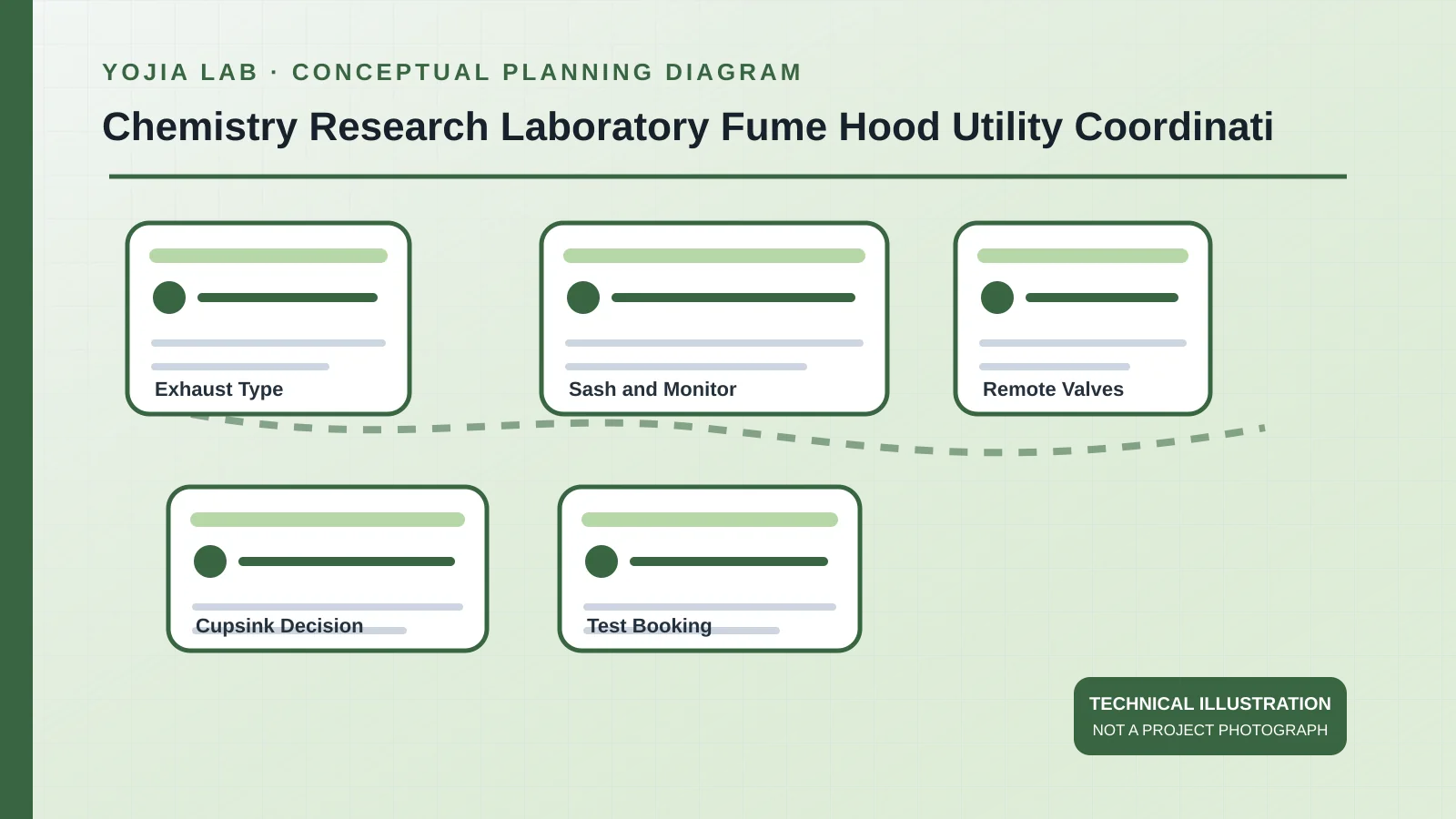
Hold the base, the fittings, and any interior lattice until exhaust type, monitor, remote valves, the cupsink decision, and the test booking are accepted. If a group later changes volume type or adds perchloric work, reopen the line. Exhaust hoods and service fittings can follow the accepted lines. They do not set face velocity, and they do not replace the chemical hygiene officer. The diagram shows five planning zones. It is not a built room.
Before pricing, place the room interface, quantities, and service points for the laboratory fume hood systems with the workflow notes above. Airflow, performance, and compliance stay with the project's responsible reviewers.