01
The comparison bench is a waiting surface
NIST GMP 10, dated 6 May 2019, sets the weights in or near the balance for 24 hours before a calibration. OIML R 111-1:2004 Annex B says classes E1, E2, and F1 should already be close to the weighing-area temperature. Table B.2 gives minimum times by class, mass, and the temperature step, with 24 hours as the practical guideline. A wall laboratory bench covered with paperwork has no place for that wait.
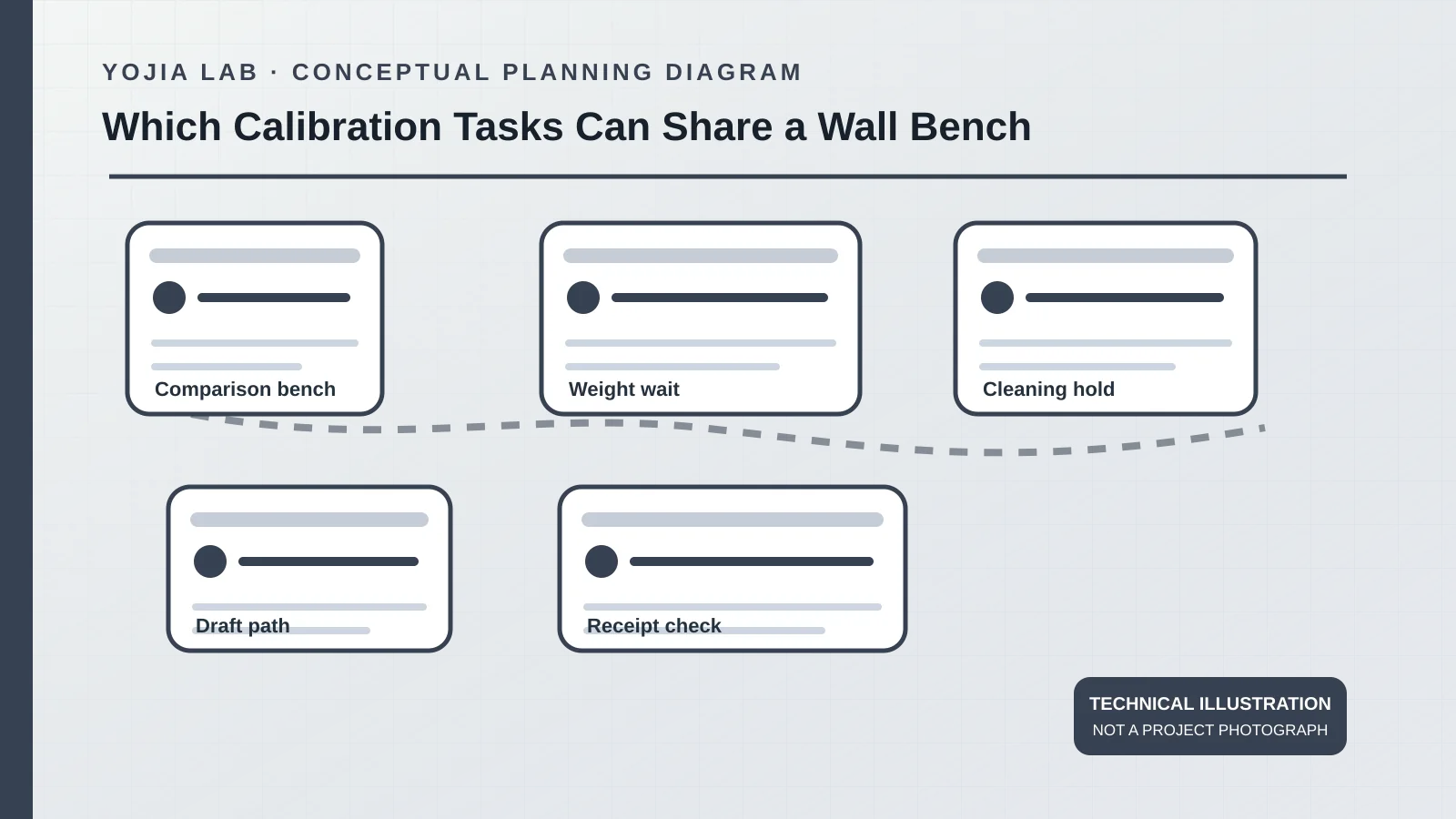
The hours are not one number. In the ±20 °C block of Table B.2, a 1 kg to 5 kg class E1 weight is listed at 18 hours and a 10 g to 50 g class E1 weight at 2 hours. The large-mass end of that block, 1 000 kg to 5 000 kg in class F1, is 79 hours. NISTIR 6919, January 2002, printed the same hours from the then-draft table and warned that a short wait creates thermal air currents around the pan. The comparison wall laboratory bench needs empty length beside the balance for the class actually handled. A shelf in another room does not meet the words in or near the balance.
02
A few degrees already moved the reading
GMP 10 separates a high-precision room from a general laboratory room. For high-precision work it says temperature should not vary by more than ±1 °C in 24 hours through the year, and by less than 0.5 °C during one measurement series, typically under one hour. It says general laboratory measurements can probably withstand ±2 °C per day. Relative humidity should stay between 40 percent and 60 percent, the band it attributes to balance manufacturers and to OIML R 111. Below about 40 percent, it says electrostatic charge can make precision weighing impossible. These are procedure limits for the weighing, not a claim that a bench controls the room.
The same paper reports two measured consequences of a bad split. On 20 g standards of very different shape, tests showed errors as large as 0.2 mg for a 4 °C difference between the standards and the balance. At 1 kg, errors as large as 3 mg appeared when standards sat in a cabinet and the unknowns sat near the balance across a 2 °C gradient, against an expanded uncertainty under 0.1 mg. Those figures belong only to the loads NIST names. They are enough to refuse a layout that stores the reference set on another wall.
03
Cleaning and receipt are not the same bench
OIML R 111-1 Table B.1 starts a second clock when solvent touches the weight. After alcohol, class E1 is held 7 to 10 days, class E2 for 3 to 6 days, class F1 for 1 to 2 days, and classes F2 to M3 for 1 hour. After distilled water the same groups wait 4 to 6 days, 2 to 3 days, 1 day, and 1 hour. The recommendation says the weight must be stabilized for those times, and that cleaning can change the mass. A wash tray on the comparison wall laboratory bench puts wet solvent and a multi-day hold where the balance needs to stay dry.
Receipt has its own gate. GMP 10 says frost or condensation is common, and may be invisible, when outdoor conditions differ from the laboratory by more than 10 °C. Annex C of R 111-1 labels its table as typical recommended values, not a building code. For classes E1 and E2, temperature should stay within 18 °C to 27 °C. During calibration, E1 is limited to ±0.3 °C per hour and ±0.5 °C in 12 hours; E2 is ±0.7 °C per hour and ±1 °C in 12 hours. E1 humidity is 40 to 60 percent, within ±5 percent over 4 hours. A receiving wall bench can hold the case until condensation is ruled out. It is not the comparison bench.
04
Drafts and vibration have to stay fixed
GMP 10 limits air speed in the mass area to less than 2 m/s and says the balance should sit away from heating and cooling vents. Closing a vent only during a weighing is rejected, because interrupting temperature control can push the balance past the procedure limits. NISTIR 6919, chapter 3, is stricter about permanence. Draft shields, redirected vents, or closed doors must remain in place during daily use, or the calibration uncertainty statement does not stay valid. Vibration sources must be limited for daily use, not only for the calibration visit. The balance should stay on long enough for its hardware to reach a stable temperature, and it should be level.
That is the zoning test. The comparison wall laboratory bench keeps the door closed, the vent path off the pan, and the fixings away from a compressor or a corridor. A second run takes cleaning, receipt, and records. Joining them because only one wall is free recreates the cabinet-to-balance gradient NIST measured. Bench length does not supply the 18 °C to 27 °C band or the 24-hour stability OIML asks of the room.
Before pricing, place the usable wall length, modules, and service points for the wall laboratory bench run with the room notes above. Final materials and supplied scope remain the approved quotation.