01
Give master-mix aliquots an island bench of their own
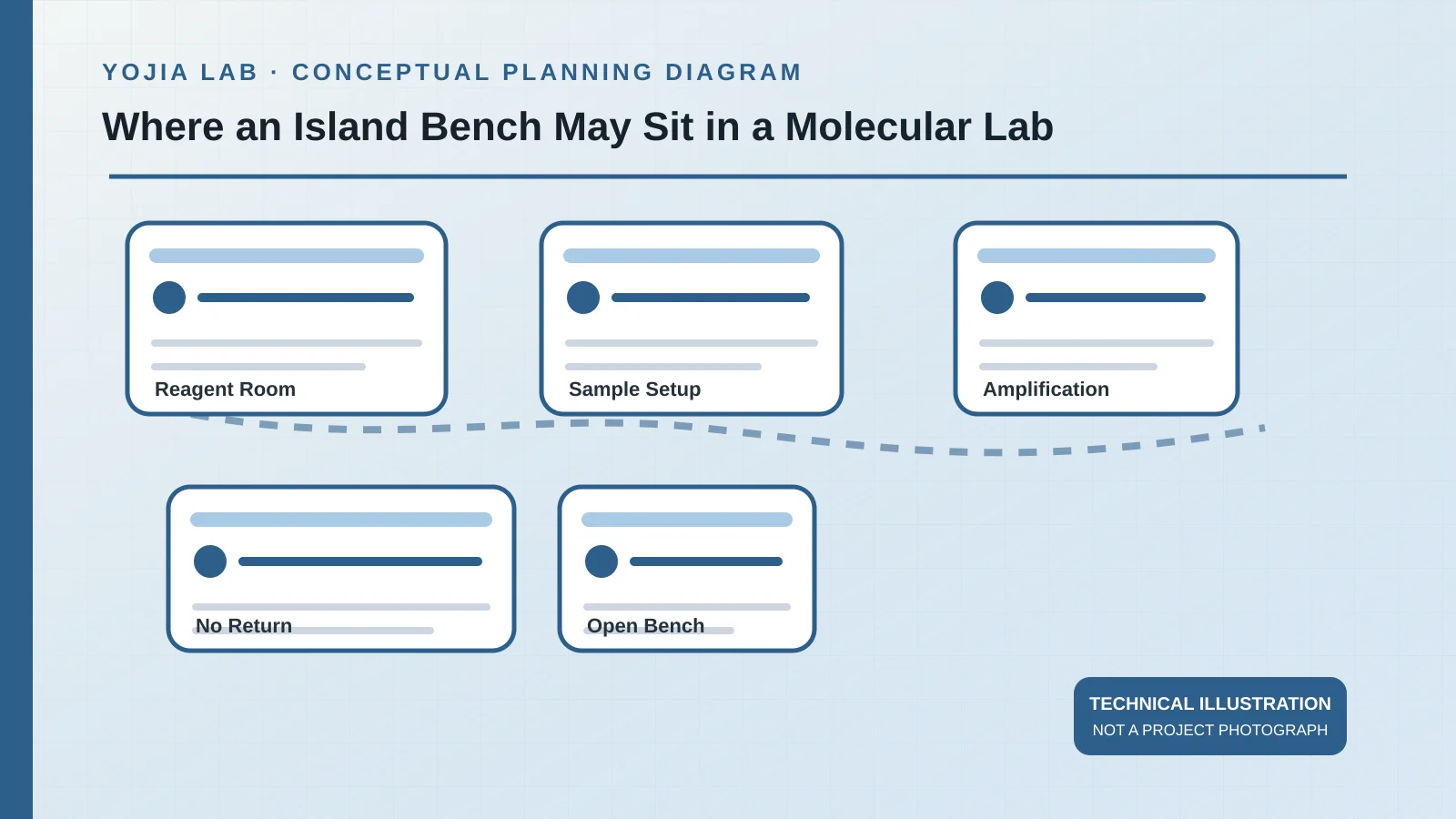
CDC's MMWR recommendations state that amplification not contained in a closed system needs a unidirectional workflow, with separate areas for reagent preparation, specimen preparation, amplification, and product detection. A closed system, in that text, purifies, amplifies, and detects without the user opening tubes of amplified material. Start with the assays. If they are closed systems used as instructed, do not invent three rooms of benches for a rule written for open workflows.
Where the workflow is open, the University of California, Davis real-time PCR core limits the reagent room to preparing and storing reagents, aliquoting stocks, and adding master mix to tubes. Dedicated pipettes, aerosol-barrier tips, coats, and gloves stay there. Nothing from sample preparation or amplification, including positive controls, enters. An island bench in that room serves those aliquots and reagent racks that also never leave. It is not a spare table to wheel onward when a run is large.
02
Add nucleic acid on a different island bench
The same Davis core puts extraction and the addition of samples and controls into a second room. Tubes that already contain master mix receive nucleic acid there. Coats, gloves, and pipettes are a different set. The core uses one biosafety cabinet for sample and negative-control work and another for positive controls, so those activities do not share a chamber. An island bench here, if the procedure allows an open surface, covers only the steps named as open. It does not replace the cabinet.
A University of California, San Francisco teaching procedure notes that some laboratories add DNA on a pre-PCR bench and others use a laminar-flow hood. The feature it treats as essential is one-way movement, not a particular bench shape. Ask which surface the protocol already names. If it says cabinet, the island bench line for that step is zero. If it says open bench, that island bench stays in this room and does not also aliquot reagents.
03
Leave amplified material where it was made
The Association of Public Health Laboratories calls the amplification room the dirty room. Thermocyclers, gels, and tubes of amplicons stay there, and protective clothing worn there is not worn into the clean rooms. CDC adds that a no-template control should travel with the run so carryover can show itself, and that making control material by amplification can itself contaminate a laboratory. The furniture consequence is simpler: an island bench in this room is a third object, not the reagent bench moved over for the afternoon.
If the amplification room is too small for an island bench, do not let the pre-amplification island bench accept plates after the run. Record a smaller fixed surface, or record that post-PCR work has no furniture line yet. Gels and opened tubes do not travel back for a second setup. APHL says amplified products should not leave the post-PCR room. A bench across the doorway would break that instruction.
04
Freeze carts, racks, and pipettes to one room
Davis states that equipment is not moved between the reagent, sample, and amplification rooms, and that notebooks stay put. A cart counts as equipment. Mobile furniture on this sheet gets a room and a job: stocks only to the reagent island bench, extracted nucleic acid only as far as the sample room, and amplification waste only toward that room's building exit. A shared cart in the corridor is a bridge the workflow forbids.
Reagent racks follow the same freeze. A rack for master-mix aliquots does not later hold amplified plates, even if the dimensions match. Count racks per room, and give any spare a home room too. The Davis guidance treats coats as contamination controls, cleaned with coats from the same area and removed before a person leaves amplification. The drawing can show a hook. It cannot show one hook for all three rooms.
05
Say what the island bench is not
CDC biosafety guidance for level 2 calls for a biosafety cabinet or other containment when work may splash or aerosolize infectious material. Some molecular steps are that work, and some are not. The island bench is only the open surface the protocol allows. It is not containment, and placing it carefully does not change a risk assessment or approve infectious work on an open top. Those decisions stay with the institution's biosafety review.
The sheet that can be priced names three rooms or states that the building has fewer, lists the island bench length in each room allowed to have one, and lists the cabinet and mobile pieces forbidden to cross. A phrase such as PCR suite does not do that work. If a closed system later replaces the open workflow, revise the island bench lines.
Before pricing, place the room dimensions, user sides, and service interfaces for the island laboratory bench layout with the workflow notes above. The final configuration remains the approved quotation and drawings.