01
Split the solid, the acid, and the solution
A U.S. Geological Survey method (Open-File Report 96-525, method M020) makes rare-earth elements in geologic material soluble by sodium-peroxide sintering, water leaching, and nitric-acid acidification. That is one published preparation path, not a universal room recipe. It means the method owner must identify where the furnace step happens, which crucibles and bottles are used, and whether those materials enter the storage room at all. Keep the dry incoming sample, preparation reagents, and resulting solution as separate storage rows.
Write the sequence for this laboratory. Some groups never digest solids where concentrates are kept, and some keep instrument solutions away from acid bottles. If a step does not happen here, leave the row blank instead of borrowing a cabinet. Name who puts a container back. A tidy shelf becomes a mixed shelf when the person opening the acid and the person logging the powder both use it as a ledge.
02
Treat one published digestion as a list of bottles, not a room recipe
A USGS open-file report for a drainage-basin study describes a four-acid preparation using nitric, perchloric, hydrofluoric, and hydrochloric acids, then a transfer into polyethylene bottles. The same note lists minerals that resist that attack, including monazite, a rare-earth mineral. A laboratory working on monazite-bearing material cannot treat that write-up as its acid list. One digestion can name several strong acids while a mineral of interest still sits outside what those acids dissolve.
Copy an acid onto the schedule only after this laboratory's method owner confirms it. Hydrofluoric, perchloric, nitric, and hydrochloric acids are separate rows. Princeton's corrosive-materials page calls perchloric acid a powerful oxidizer that must stay away from organic materials. Hydrofluoric acid is not the center of that mineral-acid note, so it needs its own decision. Record concentration, container size, and whether the bottle is stock or a working dilution.
- USGS Open-File Report 96-525 reports approximately 40 samples per person-day for method M020. Treat this as throughput for that published procedure, not a staffing promise or a storage-capacity allowance.
- The method processes five procedural blanks for calibration and runs its standard solution every 15 sample intervals. Use those batch details to ask what the local method must label, retain, and stage.
- Its lower reporting limits vary by element: the report lists 0.1 ppm for europium and 1.0 ppm for lanthanum. These analytical limits do not determine cabinet, shelf, or waste capacity.
03
Ask whether polypropylene belongs on any row
Princeton's corrosive-materials page says mineral acids, including phosphoric, hydrochloric, nitric, sulfuric, and perchloric acid, can sit in a cabinet meant for corrosive acids. It describes those cabinets as non-metallic, without internal metal parts, with an acid-resistant coating and a floor meant to hold a spill. That is one university's description, and it is not a polypropylene specification. On that page, acetic acid stays apart from mineral acids, and nitric acid may be grouped with oxidizers.
If polypropylene is proposed, put that row beside the liquids someone wants inside it. Ask for a compatibility note naming the acids, concentrations, contact time, and the carcass, shelf, hinge, and spill lip. A family name does not answer hydrofluoric acid or a solvent sharing the room. Dry powder does not need a polymer cabinet added for a matching package. That office also says corrosive liquids belong below eye level and should not live inside the hood.
- Princeton EHS gives 18 inches of clearance below sprinkler heads above cabinets. This is Princeton guidance; verify local fire/building rules and the actual sprinkler layout.
- Where sprinklers are absent, the same page gives 24 inches of overhead clearance. Do not carry that campus value into another project without checking its authority having jurisdiction.
- The page advises storing materials below 5 feet (about 1.5 m) and corrosive liquids below eye level. Confirm the facility’s shelf ratings, user reach, and local EHS requirements.
04
Keep references and residues from sharing a working shelf
Retained pulps, reference materials, and solutions the instrument has already read are not leftovers. A reference exists so a later result can be compared with a known material. If it sits in the acid tray, the comparison is already muddled. Give references a dry, labeled address and a named custodian. Give spent digestates their own waiting address, with the vessel and the person who disposes of them. Unlogged concentrates should occupy neither address.
Princeton's storage page rejects alphabetizing as segregation. Sort by physical state, then by reactivity group, then arrange a group so a bottle can be found. Secondary containment is recommended where space is tight. Ceiling clearance and a warning against wall-mounted chemical shelves are that campus's rules. Show solids apart from liquids, mineral acids apart from bases and organic acids, and a blank where the local rule is unconfirmed.
05
Leave the hygiene-plan blanks on the sheet
Where OSHA's laboratory standard applies, the employer keeps a written chemical hygiene plan available to employees and reviews it at least annually. For particularly hazardous substances, the plan must, where appropriate, set a designated area, consider a hood or a glove box, and describe waste removal and decontamination. A designated area may be the whole room, part of a room, or a device. It still belongs to the chemical hygiene officer.
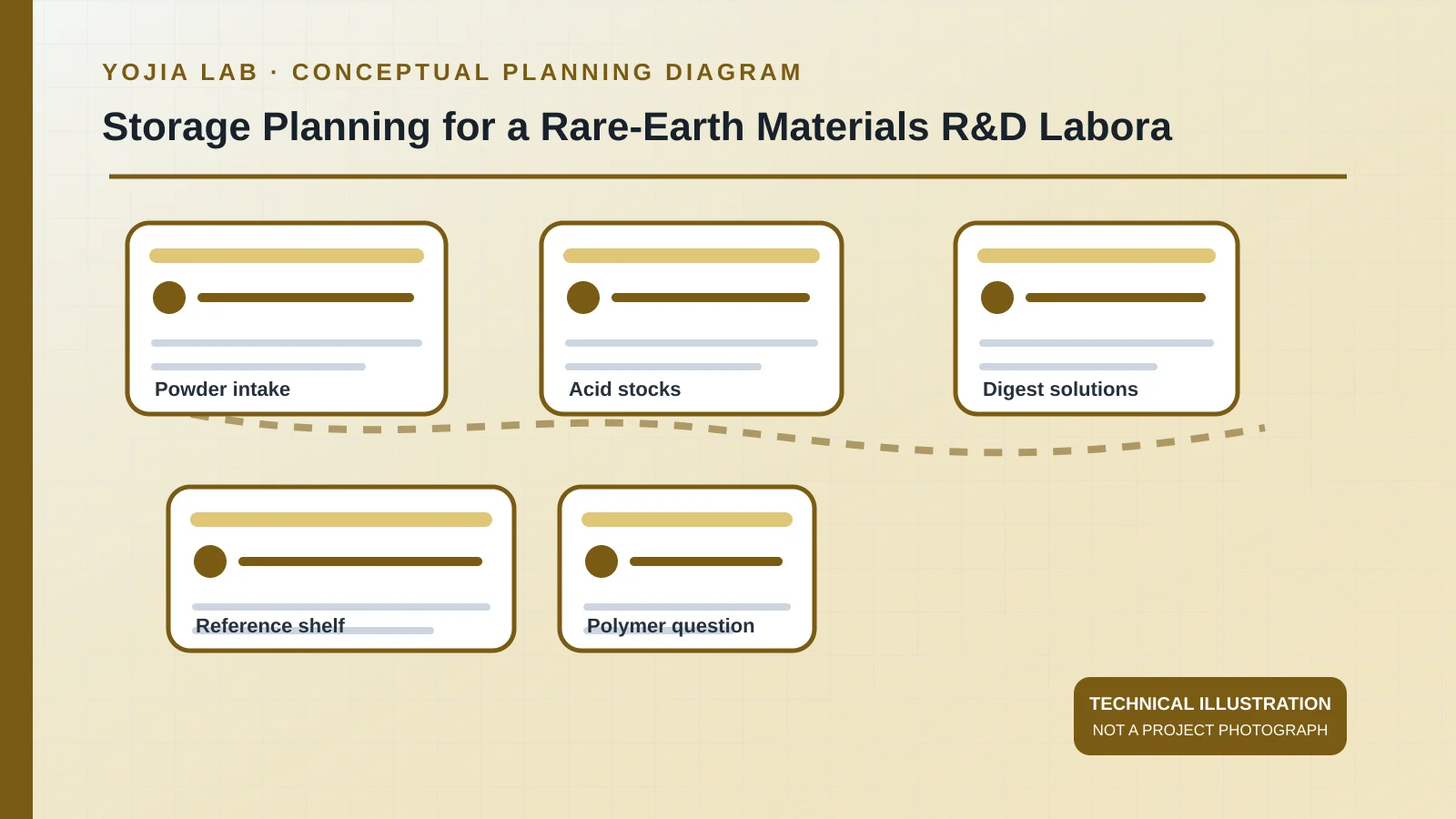
Until that officer, or the equivalent reviewer where the standard does not apply, marks the designated area and the waste path, those cells stay empty. An empty cell is not a reason to add a polymer cabinet, and it is not a statement that the room has met the standard. The illustration groups powder intake, acid stocks, digest solutions, a reference shelf, and the polymer question. It is a diagram, not an installed cabinet or a hygiene plan.
Where the storage duty is considering a polymer cabinet or bench, review polypropylene laboratory furniture on its own. A material name does not show that it fits the chemicals, cleaning method, or fire requirements.