01
Start with the test portfolio, not the furniture schedule
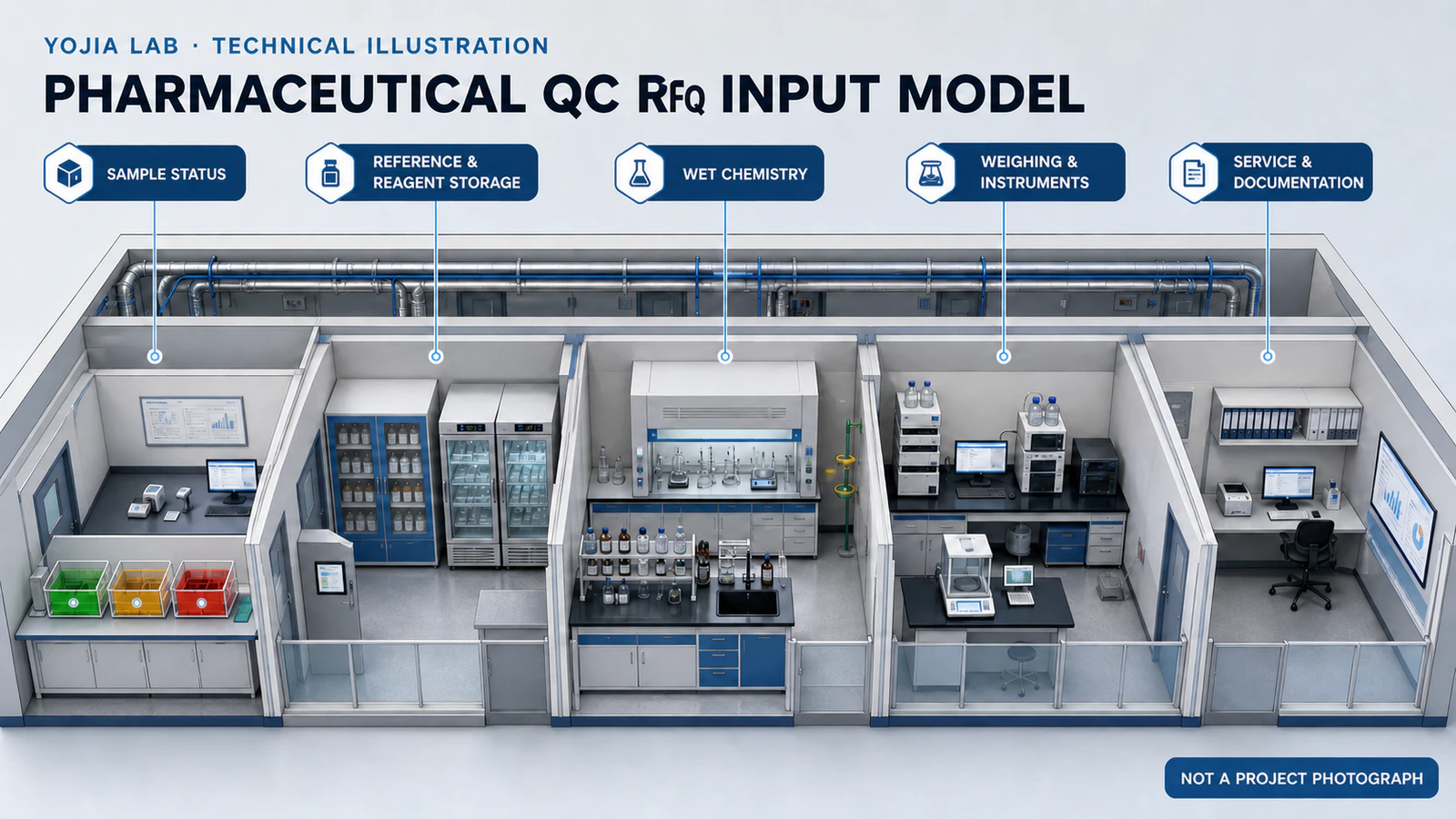
The owner should issue a method-and-material register before asking for furniture quantities. For each incoming material, in-process sample, finished product or stability pull, record the method family, preparation steps, solvent or reagent burden, containment concern, batch rhythm and data hand-off. This reveals whether apparently similar bench work actually needs separation, local extraction, controlled weighing, cold staging or protected reference-material access.
Turn that register into operating scenarios rather than one average day. Include routine release work, peak sample arrival, an out-of-specification investigation, instrument downtime, a spill, maintenance access and a future method transfer. The furniture RFQ can then distinguish fixed interfaces from adaptable capacity. It should state assumptions explicitly instead of asking bidders to infer throughput or compliance intent from a floor plan.
02
Give every instrument a service and maintenance envelope
A model-specific equipment schedule is the bridge between analytical work and the room. Record footprint, operating weight, point loads, door and delivery path, operator posture, heat output, allowable vibration, electrical supply, backup power, gas purity and pressure, water, drainage, exhaust, network and monitoring connections. Where a model is not frozen, identify the bounding assumptions and a decision date rather than drilling provisional service holes.
The schedule must also reserve the space that appears only during ownership: rear-panel access, side clearance, consumable replacement, calibration setup, service-tool placement and safe isolation. Locate shutoffs and disconnects so they can be identified and reached without moving an instrument. Require coordinated bench, hood, utility and equipment drawings, because a vendor's cabinet elevation alone cannot demonstrate that the assembled workstation remains serviceable.
03
Make sample status and controlled storage visible
Pharmaceutical QC storage is not one undifferentiated cabinet count. The RFQ should map receipt, quarantine, released-for-test, under-investigation, approved, rejected and retained states, then assign access, labelling, environmental and capacity rules to each. Samples, reference substances, volumetric solutions, general reagents and cleaning chemicals have different identities and control needs even when their containers fit the same shelf module.
Issue an inventory by compatibility and operating location. Separate bulk reserve from point-of-use stock, define locked or monitored storage, and identify flammables, acids, bases, oxidizers and other exceptional groups for project-specific review. Include refrigerator and freezer footprints, door swing, heat rejection, alarm ownership and emergency transfer strategy. Waste should have a documented hand-off route so spent solvents and test residues do not become an improvised under-bench storage problem.
04
Specify workstations as cleanable, maintainable systems
Select worktops, liners, sinks, joints, plinths and cabinet interiors from the actual exposure and cleaning matrix. A single premium material everywhere can still be the wrong answer: wet digestion, balance work, chromatography preparation and document review impose different chemical, dimensional and ergonomic demands. State which surfaces need seamless transitions, removable access panels, raised equipment supports or containment edges, and require material samples for review before fabrication.
Furniture modules should support controlled change without weakening the known interfaces. Define levelling range, load basis, anchorage, utility-panel strategy, cable segregation and the limits of movable components. For fume hoods, state the method duty and project exhaust basis while leaving airflow design and acceptance to the responsible professionals. For balance and instrument stations, coordinate vibration, heat, drafts and maintenance clearance instead of treating the bench as an isolated product.
05
Close the RFQ with responsibilities and acceptance evidence
A scope matrix should name who surveys existing conditions, confirms equipment data, provides each service, seals penetrations, labels isolators, connects instruments and resolves clashes. It should distinguish factory documentation, site installation checks, commissioning records and equipment-qualification support. Furniture suppliers can provide defined drawings, material records and installation evidence, but the laboratory retains oversight of methods, risk decisions and the complete qualification strategy.
Ask every bidder to return the same compliance table: included scope, exclusions, deviations, assumptions, lead-sensitive decisions, proposed alternates and required owner inputs. Compare maintainability, change exposure and evidence quality alongside price. Before release for manufacture, hold a cross-disciplinary review against equipment user requirements, room data, sample states and cleaning procedures. That review is the practical point where a furniture quotation becomes a coordinated laboratory delivery package.