01
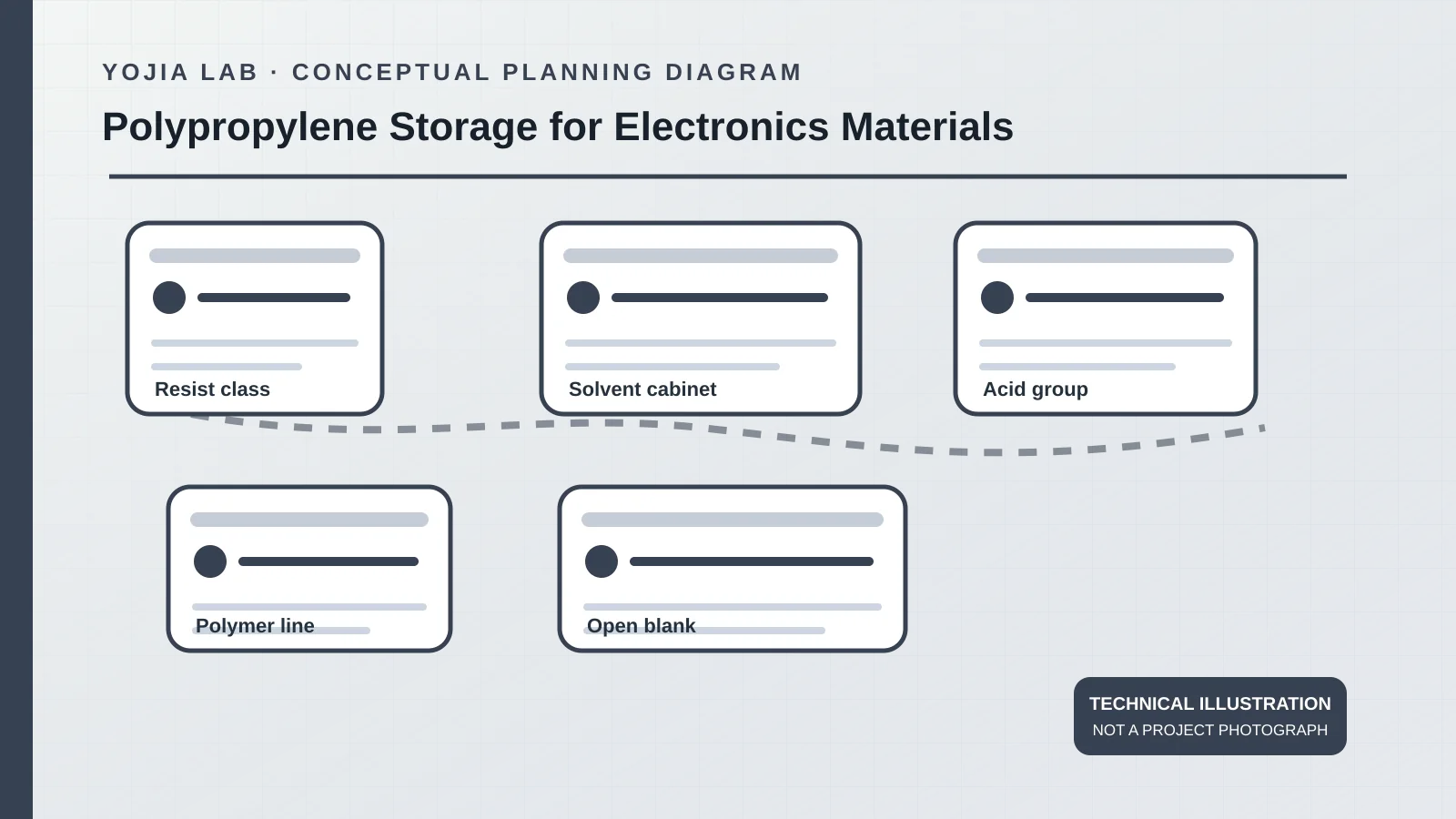
Name the resist class before counting shelves
Cornell’s NanoScale Facility tells users that photolithography materials are organized by compatibility and must stay apart. Resist is stored, spun, and baked in the same room, and the facility assigns different classes to different rooms: most positive resists in one, epoxy and lift-off products such as SU-8 in another, and e-beam resists in their own room. Those room numbers belong to that building. A storage note that says only “chemicals” is too coarse, because the class decides the address.
Etch acids are not a fourth resist class. Cornell’s segregation scheme keeps inorganic acids, oxidizing acids such as nitric and perchloric, and hydrofluoric acid on different lines. Hydrofluoric acid is separated from the other acids, and the scheme calls for polyethylene containers for that acid. Oxidizing acids are directed to non-combustible, non-metallic storage and away from organics. Write those lines before anyone proposes a cabinet material. A mixed shelf of resist solvent and nitric acid is not a layout to price.
02
Point solvents at a rated flammable cabinet
The National Academies’ chemical-management chapter says to store flammable liquids in approved flammable-liquid storage cabinets, to keep chemicals off the benchtop except while they are in use, and to keep them out of the chemical hood except for the task underway. A coater that is idle does not turn the hood into overnight storage. The same chapter asks for a definite place for each chemical and for incompatible groups to stay apart, including when fugitive vapor can spoil labels and shelves.
Cornell’s laboratory manual sets its own quantity test: if the laboratory holds more than 10 gallons of flammable liquids, counting material already in use, those liquids go into an adequately rated flammable cabinet, and flammable liquid that is not in use stays in that cabinet. Cornell also says a cabinet that is not vented keeps its metal bungs in place so the fire rating remains, and that venting is optional and must follow the maker’s instructions. That is Cornell’s rule for Cornell laboratories. Another site may use a different threshold. Either way, the solvent line names a rated flammable cabinet. It does not name polypropylene storage.
03
Open a polymer line only for the acid family
Cornell’s storage guidelines say corrosive liquids go in corrosion-resistant cabinets, stay at or below eye level, and sit in secondary containment. The guidelines also say not to store acids inside flammable cabinets, because acid vapor attacks the cabinet and the containers in it. The stated exception is an organic acid that is also flammable: acetic acid at or above 80 percent belongs with the flammables. An etch bath of hydrochloric or nitric acid is not that exception. The acid line and the solvent line remain two cabinets.
None of those sentences approves a polypropylene cabinet for a named etchant. Cornell’s scheme asks for non-metallic storage for oxidizing acids and for polyethylene containers for hydrofluoric acid. A furniture note that says only “polymer” has not chosen between those instructions, and it has not read the safety data sheet. Put the chemical name and the institution’s group on the row. Leave the cabinet construction empty until a reviewer who has the sheet accepts a material. Polypropylene storage is the question on that acid row. It is not the answer.
04
Do not spend the floor or the hood as spare volume
The National Academies recommend keeping stored materials at least 18 inches below sprinkler heads, keeping shelves at or below about 5 feet so people are not reaching overhead, and putting heavy containers low. They also say volatile toxic or strongly odorous chemicals belong in a ventilated cabinet, checked with the institution’s safety office. Those are placement limits. They are not a capacity claim for any cabinet, polymer or metal.
Cornell adds that chemicals do not belong on the floor, because floor storage trips people, spreads a spill, and blocks the way out. Its secondary-containment note asks the tray to hold at least 110 percent of the largest container, which the manual describes as consistent with 40 CFR 264.175 and adopts as its own practice. A shallow tray under a bottle is not the same object as a polypropylene bench or cupboard. Do not inflate under-bench volume by standing carboys on the floor or by parking the week’s bottles in the hood.
05
Freeze only the family that already has a cabinet type
A quotation can record how many cabinets the institution has already assigned to a named family, plus the shelf limits that family already carries: eye level, containment, and separation from the neighboring family. It can show that photoresist solvent points at the rated flammable cabinet. It cannot state that polypropylene resists a named etch acid or a photoresist solvent.
If the safety data sheet is still missing, the construction cell stays empty and the quantity can stay empty with it. Inquiry reference codes identify the conversation. They are not a test report. Send the class list, the solvent-volume note, and the acid split with the sketch. A later change of resist class adds a row. It does not reuse yesterday’s cabinet.
Where the storage duty is considering a polymer cabinet or bench, review polypropylene laboratory furniture on its own. A material name does not show that it fits the chemicals, cleaning method, or fire requirements.