01
One hundred and one thousand are the printed limits
Category 1 covers products for children under 3 years, the eye area and mucous membranes. Category 2 is other products. Table A.9, given as the limits of EN ISO 17516:2014, which the notes say CEN approved on 9 August 2014 and confirmed in 2020, sets total aerobic mesophilic microorganisms, bacteria plus yeast and mould, at or below 1 × 10² CFU per gram or millilitre for Category 1 and at or below 1 × 10³ for Category 2. Escherichia coli, Pseudomonas aeruginosa, Staphylococcus aureus and Candida albicans are each to be absent in 1 g or 1 ml, in both categories. A footnote says that, because plate counts vary, and according to USP Chapter 61 or European Pharmacopoeia Chapter 2.6.12, a result is out of limit above 200 CFU/g or ml in the first column and above 2,000 in the second. Those figures are the interpretation note. They are not a second specification, and the chapters named in the footnote were not re-read for this article.
Routine analysis is described for each finished batch placed on the market, with criteria, methods and results filed in the product information. Alcohol above 20 percent is the example given for a justified case where end-product testing is not necessary, with a pointer to ISO 29621:2010. A challenge test is separate: the product is contaminated on purpose and must fall back to the category limit. The organisms named are Pseudomonas aeruginosa, Staphylococcus aureus, Candida albicans and Aspergillus brasiliensis. The notes say consistency depends more on whether that organism can contaminate the product than on taxonomy or media, and that preservative effect must be neutralised by dilution, filtration or another means. A microbiologist carries out or supervises the work and validates it. No universal legal method is declared. The same pages say counts and challenge tests do not apply directly when live organisms were added on purpose.
02
The 2013 draft speaks about rooms, not a worktop
FDA’s cosmetic GMP draft was revised in June 2013, after texts dated 1997 and April 2008. It binds neither FDA nor the public, and should means a recommendation. Buildings should be suitable, clean, and organized enough to limit mix-ups among raw materials, in-process material, finished product, containers and labels. Floors, walls and ceilings should be smooth and easily cleanable. Lighting and ventilation should be adequate and, where control needs them, so should humidity, temperature and bacteriological controls. Condensate should not drip onto product. Equipment should resist corrosion and dirt. Raw materials should be in closed, labeled containers, off the floor.
Laboratory controls are a different list in the same draft. Samples should represent the lot. Raw materials, including water, in-process material and finished product are examined for identity, physical and chemical specifications and microbial contamination. Finished samples and retained samples are tested for preservation under reasonable storage and use. Retained samples are kept so that integrity holds, for example against contamination and deterioration, and they are retested. None of this names a bench length. A smooth production wall is a building finish. A retained jar is a storage condition. A plate read against 100 CFU per gram is a laboratory count. The draft’s should keeps all three as manufacturing recommendations, not as a furniture catalogue.
03
What can be sent once the rooms are split
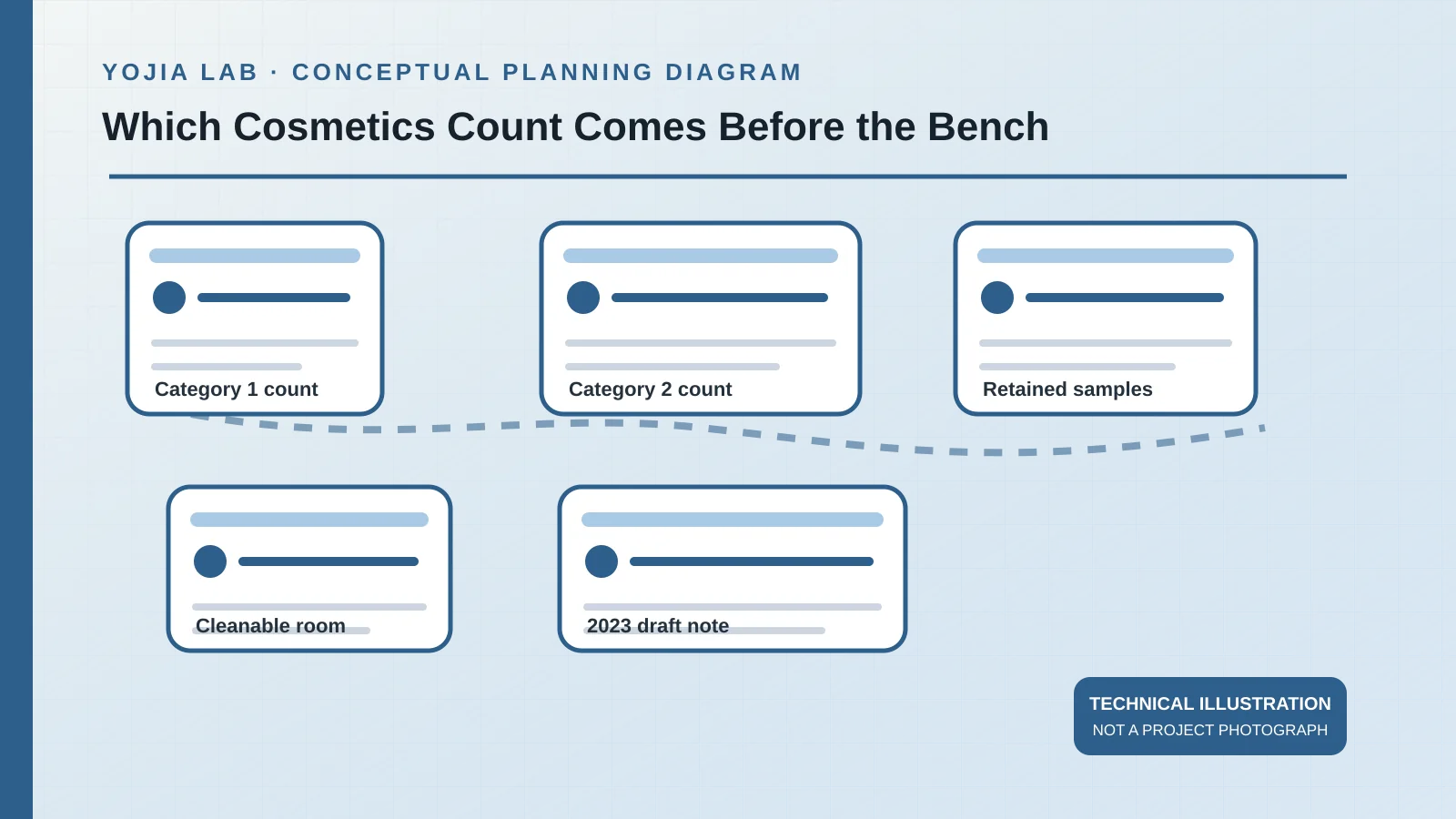
Three lines follow from what these documents actually separate. First is the place where a Category 1 or Category 2 count is made, including the footnote’s 200 and 2,000 interpretation and the microbiologist the challenge test asks for. Second is the retained-sample store, protected from contamination and deterioration and held long enough to retest. Third is the manufacturing room whose floors, walls and ceilings are the smooth cleanable surfaces, with humidity, temperature or bacteriological control only if the process needs it. One request for cosmetics laboratory furniture collapses the count, the jar and the production wall. Dimensions and service points can be answered after the three lines exist. A count of 100 CFU per gram does not become a worktop thickness.
Two limits stay on the same sheet. Alcohol above 20 percent is an example SCCS gives for skipping end-product testing, not a rule that every high-alcohol product skips the room. A brief written only as absence of named organisms is the wrong brief when viable organisms were added on purpose. The 2013 draft is also not the last word on its own status. The FDA guidance page, in a note dated 3 May 2023, says the agency intends to withdraw or revise and reissue the draft as appropriate, because the Modernization of Cosmetics Regulation Act of 2022 requires GMP rulemaking. Until that text exists, the June 2013 sentences can be quoted as recommendations, with the 2023 note beside them. They are not a current binding specification, and they do not describe a bench the draft never specified.
04
A manufacturer can answer only the line that was named
The selection question is which line is being furnished. A plate-count station keeps the table cell and the footnote apart: at or below 100 CFU per gram or millilitre is the Category 1 cell, and above 200 is the footnote’s reading of plate-count scatter. “Microbiology bench” alone drops that split and also drops Category 2’s 1,000 and 2,000. The retain line asks for integrity over an adequate time. The production-room line asks for cleanable floors, walls and ceilings. Only the named line can be drawn.
Appendix 9 and the June 2013 draft state no module width, load or chemical-resistance grade. Adding a number would turn an example into a measured requirement. The useful brief is the category, whether organisms were added on purpose, whether the station is the count, the retain store or the production room, and a reminder that the FDA sentences are recommendations the agency has said it may replace. Open items stay open. A later rule under the 2022 statute can change the room language without changing the CFU table printed in 2023.
When the plan is ready for a factory review, send the quantities, hazards, and unresolved room limits to a China laboratory furniture manufacturer. Open items should stay open rather than being written as a confirmed specification.