01
Build a storage-state register before drawing cabinets and freezer rows
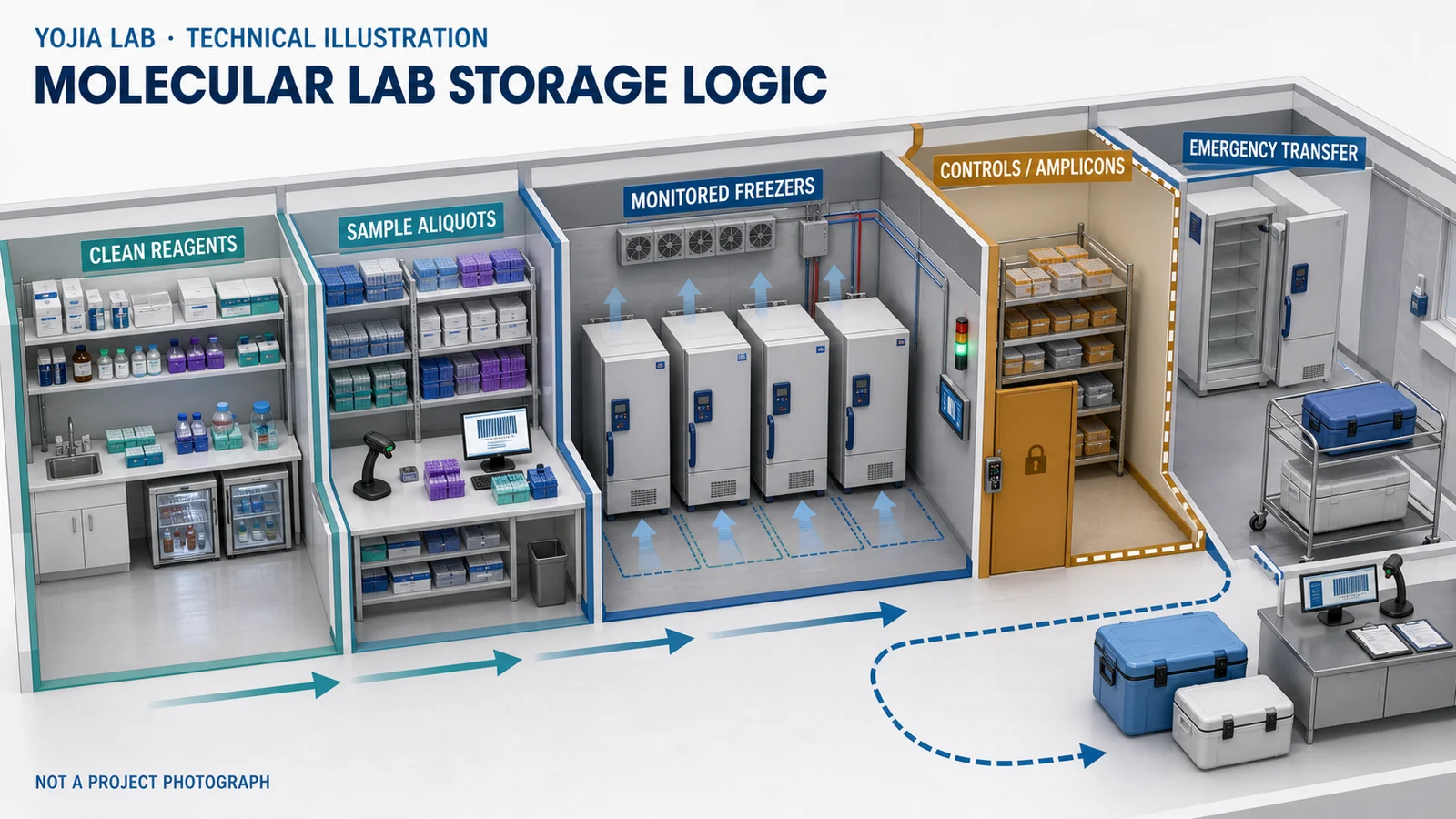
Start with one row for every material class, not one row for every appliance. Record whether an item is unopened stock, working stock, an active specimen, an extracted derivative, a positive control, an amplified product, a retained aliquot, an exception under investigation, or waste awaiting removal. Add the scientific endpoint, container and label system, approved condition, access frequency, allowable handling history, owner, retention trigger, and disposition. NCI's current biospecimen guidance links storage decisions to specimen type, duration, analyte of interest, viability needs, containers, identifiers, and documented deviations. That principle prevents a freezer temperature label from standing in for a complete material decision.
Turn the register into capacity using actual bottles, kit boxes, tube racks, plates, cryoboxes, bags, control sets, and shipping containers. Count routine stock, peak deliveries, quarantine, returns, expired material, study close-out, and space held for failure transfer. Separate usable volume from nominal appliance volume because racks, air circulation, access, and container geometry consume capacity. Assign every material a normal and an exception location. This creates a basis for shelves, lockable cabinets, reagent racks, refrigerators, freezers, and staging surfaces without assuming every cold item belongs in the nearest unit.
- Identity and material state
- Approved condition and container
- Access pattern and retention rule
- Normal and exception locations
02
Place storage inside the contamination-control workflow
Temperature-compatible materials may still be operationally incompatible. WHO molecular-testing guidance keeps amplification reagents in the clean pre-PCR space, assigns samples to designated refrigerators or freezers in the extraction area, and separates post-amplification work from pre-amplification activities. CDC likewise recommends storing amplified or synthetic control materials separately from patient specimens and testing reagents when they can become a contamination source. Apply these as method-specific planning evidence: show which people, containers, carts, documents, and reusable racks can cross each boundary, not merely which room contains a refrigerator.
Create distinct landing and return rules for clean reagents, incoming specimens, extracted material, controls, and amplicons. A refrigerator used beside mastermix preparation should not become an overflow location for opened specimens; a post-amplification freezer should not borrow clean pre-PCR racks; and unresolved or leaking deliveries need a defined exception route rather than a temporary place on a clean bench. Use dedicated, clearly coded furniture zones where the reviewed method needs them. Storage cabinets and reagent racks can make status visible and reduce unnecessary movement, but they do not establish containment, decontamination efficacy, or biosafety by themselves.
- Clean reagent domain
- Specimen and extraction domain
- Control-material domain
- Post-amplification domain
03
Treat cold storage as a room-and-utility system
A freezer schedule must reach beyond temperature and litre capacity. Capture the current model's voltage, current, plug, starting behaviour, heat rejection, noise, mass, loaded floor demand, ventilation clearance, door swing, defrost and drainage implications, communications, alarm contacts, service sides, and replacement dimensions. The NIH Design Requirements Manual is an institutional design reference for reliable research facilities, but project engineers and suppliers must define the actual structural, electrical, cooling, fire, access, and resilience basis. Arrange equipment so exhaust heat, tight clearances, blocked filters, crowded doors, or an impossible removal route do not become hidden operating constraints.
Translate criticality into an alarm-and-transfer chain. NCI recommends continuous monitoring of storage equipment, immediate warnings, regularly tested backup provisions, and written freezer-failure procedures that include transfer and custody. For this project, identify independent sensing where required, alert recipients, escalation timing, after-hours access, emergency-power scope, transfer containers, lifting and cart needs, destination capacity, and the record created during a move. Do not promise a universal hold time or backup percentage. Demonstrate the chosen response using the real load pattern, approved containers, available personnel, travel route, and destination equipment.
04
Make identification and retrieval govern the physical layout
Storage capacity is useful only when a person can locate the correct item without warming or disturbing many others. Use a unique identifier that survives the intended condition and connects to an inventory record; keep the identifier independent of a changeable physical position. Define the hierarchy from room and unit to shelf, rack, box, and position, and record every move, split, extraction, thaw event, issue, return, and disposition at the level required by the laboratory. The WHO quality-management handbook also treats receiving, inspection, reagent lot and expiry, storage condition, minimum stock, and inventory responsibility as one managed process rather than separate clerical tasks.
Let retrieval frequency shape adjacencies. Working stock belongs near its approved domain with short, clean hand-offs; archives can use denser arrangements if access, security, monitoring, and service remain workable. Provide a scan-and-verify landing surface before a door opens and for confirmation after it closes. Keep labels away from frost-prone surfaces, test barcode and glove usability, keep heavy items within the approved handling range, and preserve cart space. A specialist workstation can support aliquot handoff or inventory reconciliation, but computers and paperwork should not create a contamination bridge.
05
Commission normal retrieval, exceptions, and change
Acceptance should test stories, not just installed quantities. Receive a mixed delivery, reject one damaged item, place clean reagents and specimens into their correct domains, retrieve one aliquot by ID, record a split, return or dispose of the remainder, acknowledge an alarm, and transfer a representative load to its approved backup. Check door conflicts, scan points, label legibility, reach, rack stability, temperature-monitoring evidence, alert delivery, responder access, cart movement, cleaning, security, and custody records. Record unresolved results against a named owner before the storage system is released for use.
Issue a storage basis document linking the material register, condition schedule, location hierarchy, equipment data, alarm matrix, power and cooling decisions, furniture drawings, SOPs, commissioning evidence, and training. Reopen it when a new assay, sample type, control, reagent format, retention period, freezer model, room use, or information system changes. A periodically reconciled physical inventory, documented temperature or equipment deviations, and practiced failure response provide better change signals than a permanently full freezer. The technical illustration supports this review; it is not a construction drawing or evidence that a particular material will remain suitable.