01
The directive already separates the reagents
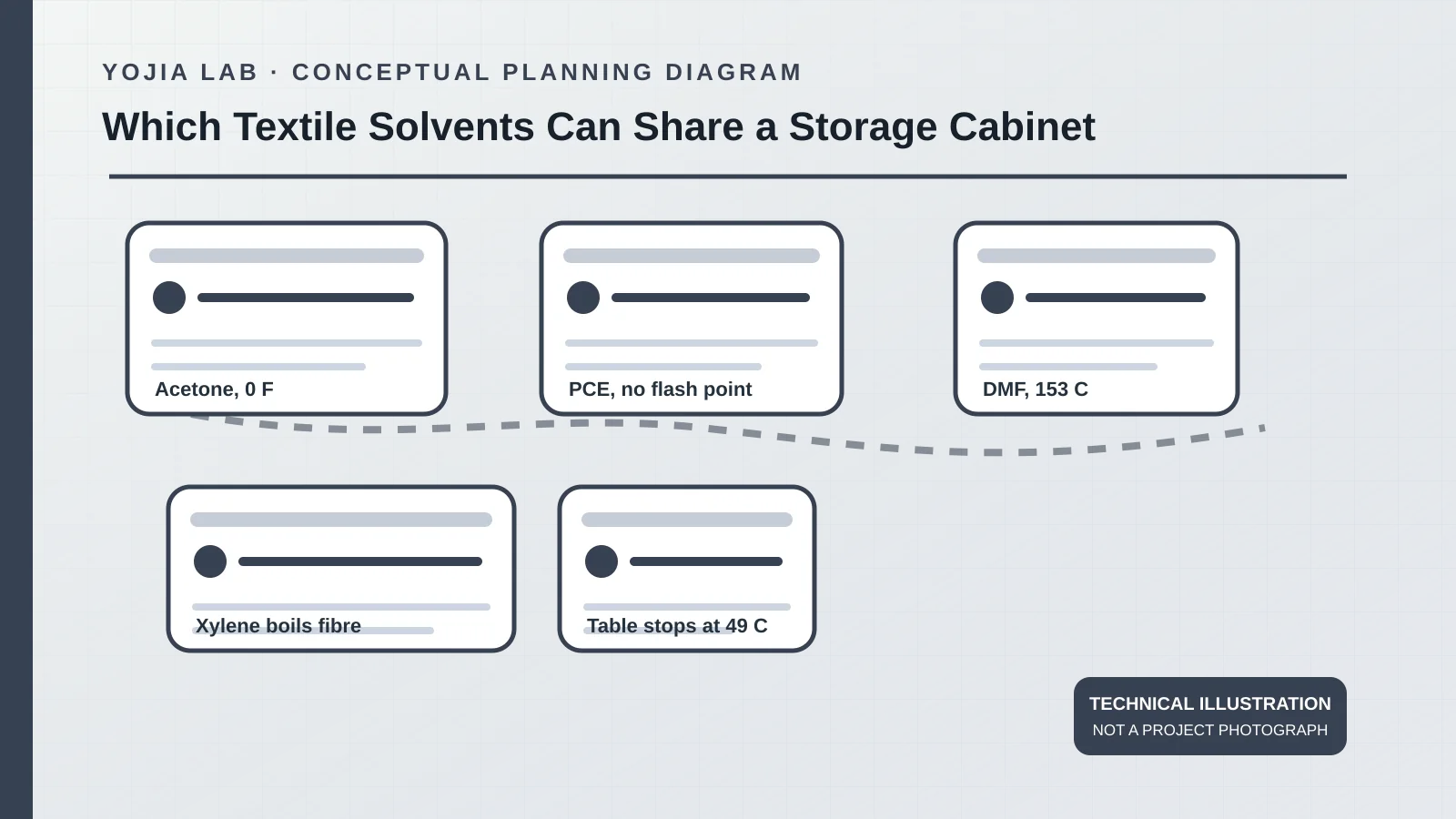
Directive 96/73/EC, published in Official Journal L 32 on 3 February 1997, sets official methods for binary textile-fibre mixtures. Method 1 dissolves acetate from a known dry mass with acetone, in a glass-stoppered conical flask of at least 200 mL. The procedure adds 100 mL of acetone per gram, stands the flask for 30 minutes at room temperature, then repeats the treatment twice for 15 minutes each, so the total time in acetone is one hour. Method 8 dissolves acrylic, certain modacrylics, or certain chlorofibres with dimethylformamide in a water bath at boiling point. The reagent’s boiling point is given as 153 ± 1°C, and it is not to contain more than 0.1 percent water. The directive says this reagent is toxic and that a hood is recommended. The charge is 80 mL per gram, already hot, for one hour, then a further 60 mL for 30 minutes.
Method 13 is a different object. It dissolves polypropylene fibre out of a dry mixture with boiling xylene that distils between 137 and 142°C. The note on the reagent says it is highly flammable and has a toxic vapour. The flask receives 100 mL of xylene per gram, is held at the boil for three minutes, and is then treated twice more with 50 mL. That dissolution is a fibre-quantification step. It is not a test of a cabinet, and it does not become evidence that a polypropylene shelf can hold the solvent that the method uses to remove the fibre. Acetone at room temperature, dimethylformamide in a boiling bath, and xylene at a boil are three storage problems before any polymer is named.
02
Acetone and perchloroethylene are not one fire class
The NIOSH Pocket Guide entry for acetone, CAS 67-64-1, page last reviewed 30 October 2019, prints a flash point of 0°F and calls it a Class IB flammable liquid: flash point below 73°F and boiling point at or above 100°F. Incompatibilities and reactivities are oxidizers and acids. The NIOSH REL is a TWA of 250 ppm (590 mg/m³). The OSHA PEL on that page is a TWA of 1000 ppm (2400 mg/m³). The IDLH is 2500 ppm, marked as 10 percent of the lower explosive limit. Those figures classify the liquid and the exposure. They are not a cabinet width, and they do not say that acetone may sit beside an acid simply because both appear in a textile method index.
The pocket-guide entry for tetrachloroethylene, CAS 127-18-4, reviewed the same day, lists perchloroethylene among its synonyms and prints the flash point as NA. It calls the substance a noncombustible liquid that decomposes in a fire to hydrogen chloride and phosgene. Incompatibilities are strong oxidizers and chemically active metals such as lithium, beryllium, and barium, plus caustic soda, sodium hydroxide, and potash. The NIOSH REL is marked Ca, with the instruction to minimize workplace exposure. The OSHA PEL on the page is a TWA of 100 ppm, a ceiling of 200 ppm for 5 minutes in any 3-hour period, and a maximum peak of 300 ppm. The IDLH is Ca at 150 ppm. A Class IB flammable liquid and a noncombustible chlorinated liquid do not become one shelf because a laboratory uses both on textiles.
03
The drycleaning solvent has a bottle condition
ISO 105-D01:2010, fifth edition, dated 1 May 2010, in the public preview, defines unqualified fastness to drycleaning as fastness to drycleaning in perchloroethylene. Clause 5.1 says a general-purpose reagent shall be used and shall be stored over anhydrous sodium carbonate to neutralize any hydrochloric acid formed. The scope requires the material to be assessed dry, with solvent alone, in containers that do not contain water, because absorbed water, or detergent plus water, can change the fastness of some materials. That is a condition on the solvent bottle and on the test container. It is not a statement about the polymer of a cabinet.
Clause 4 says the solvent may be injurious, recommends a well-ventilated area, and says containers of solvent should be opened only inside a fume cabinet or hood. Clause 6.2 describes that hood as apparatus sufficient to confine solvent vapour. The water bath that holds the test solvent is controlled at 30 ± 2°C. That temperature belongs to the test. It is not a storage-cabinet rating, and it is not the 153 ± 1°C boiling point Method 8 prints for dimethylformamide. Opening the bottle under a hood is a use control. The closed stock still has to be segregated by the fire class and the incompatibilities above.
04
A polypropylene letter stops where the table stops
LyondellBasell’s technical tip on the chemical resistance of polypropylene, footer 7972D/0715, prints Table 1 at 70°F (21°C) and 120°F (49°C). The key is S for satisfactory, M for marginal, and NR for not recommended. The footnote says the reagents are taken from ASTM D-543-87 standard reagents. In that table, acetone is S at both temperatures and dimethyl formamide is S at both. Carbon tetrachloride is NR at both. Ethylene dichloride is S at 21°C and NR at 49°C. Toluene is NR at both, and benzene is S at 21°C and NR at 49°C. The narrative says exposure to strong oxidizing agents, halogenated and aromatic hydrocarbons, and some ketones and ethers should be viewed with concern. Perchloroethylene and xylene do not appear as rows. They do not inherit acetone’s S, and they do not inherit toluene’s NR.
The same tip says laboratory tests on specimens are of limited value for real part geometry, molded-in stress, and mixtures, and it recommends testing the actual part. It also says the seller makes no warranty of fitness for a particular purpose beyond a separate contract. An S for pure acetone at 21°C and 49°C does not cover Method 8’s boiling water bath, Method 13’s boiling xylene, or a perchloroethylene bottle that the table never rated. PP laboratory furniture can be reviewed against a listed letter, at the listed temperature, for the listed pure reagent. A material name does not extend that letter to a different chemical, a higher temperature, or a mixture.
Where the storage duty is considering a polymer cabinet or bench, review PP laboratory furniture on its own. A material name does not show that it fits the chemicals, cleaning method, or fire requirements.