01
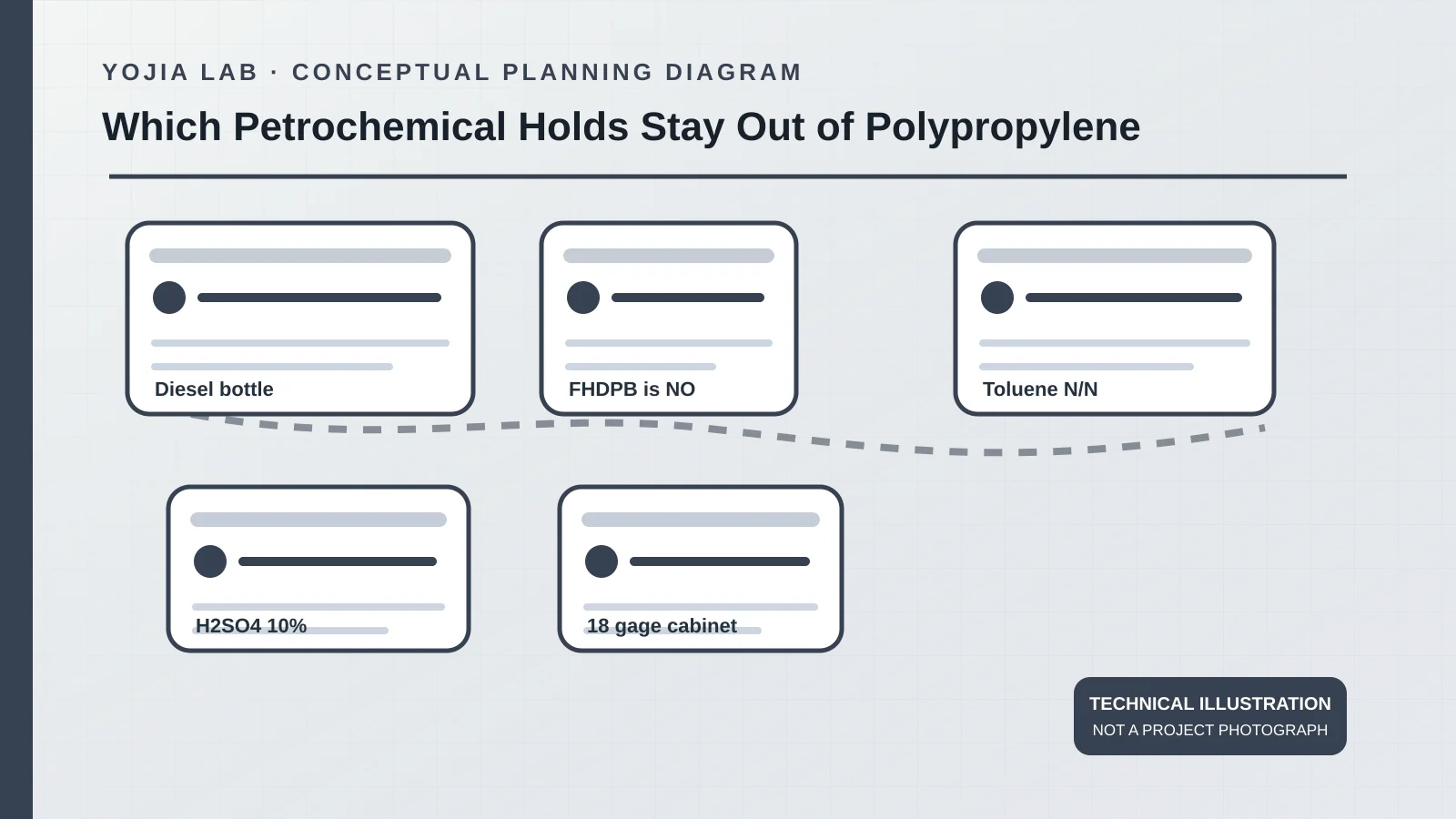
D4057 limits the sample bottle
ASTM D4057-22, API MPMS Chapter 8.1, was approved on 1 May 2022. Section 6.4 allows a suitable plastic bottle for diesel oil, fuel oil, and lubricating oil. The same bottles should not be used for gasoline, aviation jet fuel, kerosene, crude oil, white spirit, medicinal white oil, or other petroleum products unless testing shows no solubility, contamination, or light-end problem. Conventional polyethylene is barred for liquid-hydrocarbon samples. Used engine oil that may contain fuel dilution should not be stored in plastic.
Section 6.8 does not recommend plastic for long-term storage unless compatibility has been shown, and it repeats the warning on non-linear polyethylene. Section 5.5 tells pipeline samplers not to use plastic containers because they will not dissipate static. That is a sampling rule, not a 30-day immersion rating. Section 6.6's example of a dust-free cabinet at 40 °C dries the sample bottle. It is not a resistance test of the cabinet, and polypropylene furniture is not named.
02
The NIST plastic column is fluorinated
NIST Handbook 158, 2016, covers fuels stored at or near atmospheric pressure. Table 1's plastic column is labeled FHDPB. It is NO for gasoline, minimum 2 L in glass, aluminum, or metal; NO for a vapor-pressure sample, minimum 1 L; and NO for diesel, kerosene, fuel oil, aviation gasoline, jet fuel, biodiesel, E85, and methanol. Methanol is also NO for glass and aluminum, with a note toward 316L stainless steel. Those marks test fluorinated high-density polyethylene, not polypropylene.
A later note uses polypropylene for a different job. Microbiological fuel samples require a sterilized glass or polypropylene bottle, and the handbook points the sampling practice to ASTM D7464-14. Sterilization may be an oven at 160 °C (320 °F) for one hour when the cap is heat resistant, or an autoclave provided the bottle and cap are dried. The note does not reopen Table 1, so a vapor-pressure gasoline sample remains NO in the fluorinated-plastic column. The handbook does not say that every polypropylene bottle survives the 160 °C oven.
03
Nalgene letters belong to Nalgene labware
The Nalgene poster pairs letters for constant exposure at 20 °C and then at 50 °C. E is no damage after 30 days, G is little or no damage after 30 days, F is some effect after 7 days, and N is immediate damage, not for continuous use. On the polypropylene column, sulfuric acid (CAS 7664-93-9) is E/G at 1 M and at 10 percent, G/F at 50 percent, and F/N at 98 percent. Pure n-hexane (CAS 110-54-3) is G/F. Pure toluene (CAS 108-88-3) is N/N. The poster limits the chart to Nalgene products, tells the user to test actual conditions, and excludes centrifugeware and filterware.
The poster also says not to store strong oxidizing agents in plastic labware except FEP or PFA, and it lists oils among stress-cracking agents whose damage is not chemical attack. The polypropylene physical-property line gives a maximum use temperature of 135 °C, heat deflection of 107 °C, and brittleness at 0 °C. A drip on a door is not 30 days of immersion, and a furniture carcass is not the bottle that earned the letter. The NIST oven at 160 °C is above this 135 °C line, so the two documents do not make one sterilization claim for polypropylene casework.
04
A flammable cabinet is sheet iron or plywood
On OSHA's standard page, 1910.106 defines Category 1 as a flashpoint below 73.4 °F (23 °C) and a boiling point at or below 95 °F (35 °C). Table H-12 limits glass or approved plastic to 1 pint, 1 quart, 1 gallon, and 1 gallon for Categories 1 through 4. A cabinet holds not more than 60 gallons of Category 1, 2, or 3, nor more than 120 gallons of Category 4. It must stay at not more than 325 °F inside a 10-minute NFPA 251-1969 fire test, and it is labeled “Flammable - Keep Fire Away.” Deemed-compliant metal is at least No. 18 gage sheet iron, double walled, with 1½ inches of air space, a three-point lock, and a sill raised at least 2 inches. The wood alternative is plywood at least 1 inch thick.
Neither construction is polypropylene furniture. The 25 gallon Category 1 limit outside a storage room or cabinet is in paragraph (e)(2), for incidental storage. Paragraph (e)(1) says it does not apply to chemical plants, refineries, or distilleries, so a refinery laboratory does not take that figure from the incidental clause. This article does not assign gasoline or toluene to a category. Flash point and boiling point come from the safety data sheet or the method before Table H-12 sets the container size. Retained gasoline belongs on the cabinet schedule, not in a cupboard specified only as polypropylene.
Where the storage duty is considering a polymer cabinet or bench, review PP laboratory furniture on its own. A material name does not show that it fits the chemicals, cleaning method, or fire requirements.