01
The kilogram arrives with a date
Article 3 of Regulation (EU) 2026/765 says food samples shall be collected under Parts A and B of the annex. Article 5 repeals Directive 2002/63/EC and construes references to that directive as references to the regulation. Article 6 puts entry into force on the twentieth day after Official Journal publication, and application on 1 January 2027. The signature page does not print the Journal date, so that twentieth day is not calculated here. A quotation prepared before the application date should not treat Table 5 as already in force.
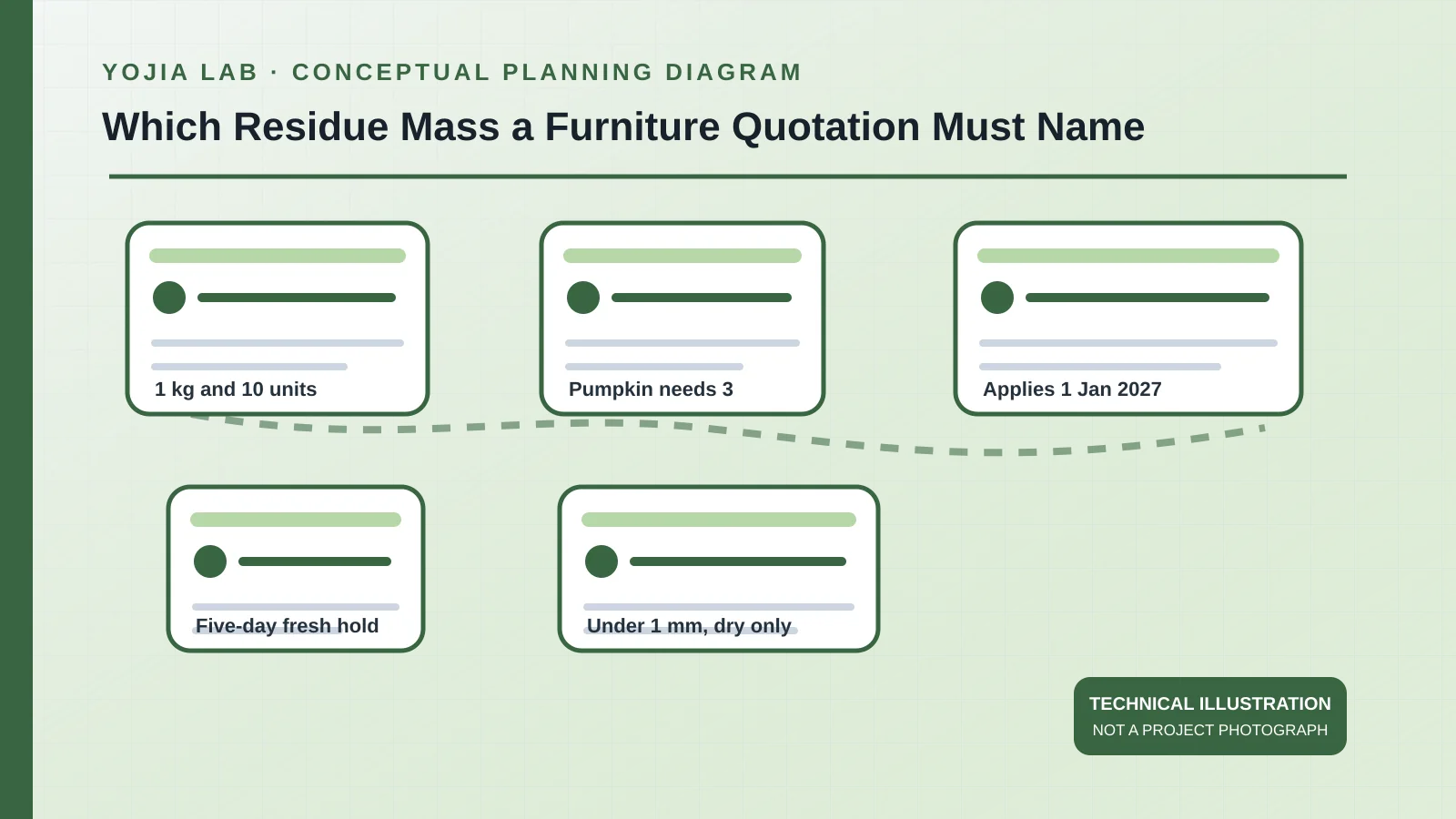
Table 5, for plants, sets 1 kg for units under 25 g (berries, peas, olives) and 1 kg but at least 10 units for 25–250 g (apples, oranges). Units of 250–1 000 g, such as cucumbers and grape bunches, take 2 kg but at least 5 units. Units over 1 000 g, such as pumpkins and melons, take 2 kg but at least 3 units. Herbs, parsley and sage included, take 0.2 kg; cereal grains take 1 kg; spices take 0.1 kg. A smaller size than Tables 4 and 5 needs a justified case, such as high value, enough material left to analyse, and a reason in the sampling report. None of these masses is a cabinet volume.
02
Codex uses a similar kilogram and a different cut
CAC/GL 33-1999 is a recommended method for checking residues against Codex maximum residue limits. Its Table 4 also lists 1 kg for fresh units generally under 25 g, and 1 kg with at least 10 units for units of 25 to 250 g. Its large-unit row is a single band, generally above 250 g, examples cabbages, cucumbers, and grape bunches, at 2 kg and at least 5 units. It does not print the European split at 1 000 g or the three-unit minimum for pumpkins and melons. Using the Codex row for a European pumpkin lot drops that three-unit line.
The herb rows diverge as well. Codex lists fresh parsley at 0.5 kg and other fresh herbs at 0.2 kg. The regulation’s herb row is 0.2 kg for parsley and sage together. Codex defines a laboratory sample as the sample sent to the laboratory, and an analytical portion as the quantity then removed for the measurement. It also says units should not be cut or broken except where its meat table allows subdivision. Those definitions are recommendations. They do not amend Article 3 of the regulation, and they do not size a bench.
03
SANTE still points at the directive it no longer outlives
SANTE/11312/2021 v2026 superseded v2 and was implemented on 1 January 2026, a year before the regulation applies. Section A3 calls it complementary and integral to ISO/IEC 17025 and says audits of official laboratories should consult it. That “should” is not a furniture clause. Section C3 still points to Directive 2002/63/EC for the expectation that processing does not significantly change the residue. Once Article 5 operates, that pointer is read as a pointer to the regulation. The quotation should say which reading it used.
Low-temperature homogenisation, frozen and/or with dry ice, is recommended only where evidence shows that ambient cutting or homogenising significantly degrades the residue. For dithiocarbamates or fumigants, if grinding affects the residue and no practical alternative exists, the portion should be whole units or segments. Otherwise, preferably the whole laboratory sample is comminuted. A size preferably under 1 mm is recommended for low-moisture goods such as cereals, spices, and dried herbs, and milling should avoid extensive heating. Those are the document’s own modals. A 1 mm screen is not a worktop dimension.
04
Storage sentences have their own forks
Section B6 says fresh products should be refrigerated, typically for no longer than five days. Dried products may stay at room temperature, and should be sub-sampled and frozen if storage is expected to pass two weeks. Section C4 calls it advisable to freeze enough subsamples for likely repeats. Section C11 says extract stability should be evaluated in validation, that a refrigerator or freezer will minimise degradation, and that room-temperature losses can occur, for example in autosampler vials. No loss rate is printed. Section F1 keeps reference standards cold, preferably frozen, away from light and moisture. A supplier expiry may be extended to 10 years from receipt only if the standard is checked on time and purity is still acceptable.
Five days, two weeks, and ten years can sit in the quotation notes with those conditions attached. None of them is a cabinet duty cycle or a bench length. The package records the instrument, the application date, the commodity row, and the comminution choice the laboratory has actually made. Open items stay open.
Before pricing, check the laboratory furniture support for distributors and contractors against the room and workflow conditions already recorded above.