01
The method already picks the vessel
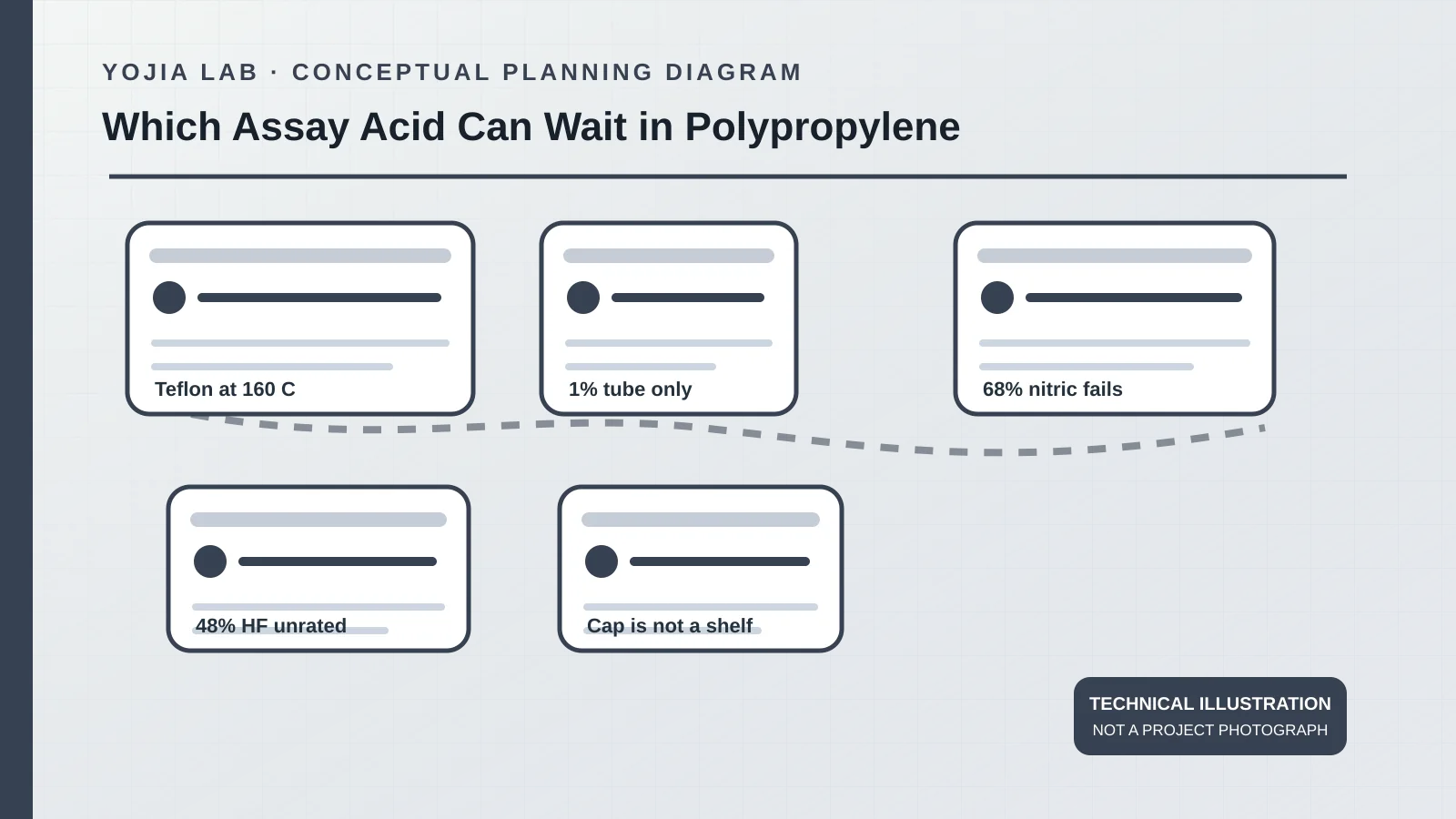
In U.S. Geological Survey Open-File Report 99-166 (1999), Briggs and Meier digest 0.200 g for a 42-element ICP-MS method in a 30 mL Teflon vessel, with reference materials, duplicates, and three blanks. The acids are 3 mL hydrochloric acid at 37%, 2 mL nitric acid at 70%, 1 mL perchloric acid at 70%, and 2 mL hydrofluoric acid at 48%. The block is 110 °C to incipient dryness, then 160 °C to complete dryness. Another 1 mL of 70% perchloric acid is dried at 160 °C. After cooling, the vessel gets 1 mL of 70% nitric acid, two drops of 30% hydrogen peroxide, and 19 mL of the report's 1% nitric acid, then 30 minutes at 100 °C while still capped and still Teflon.
Polypropylene enters one step later: 0.5 mL of vessel solution plus 4.5 mL of the same 1% nitric acid, in a capped 13 by 100 mm disposable tube until analysis. The report defines that 1% acid as 10 mL of concentrated nitric acid diluted to 1000 mL. The 100 °C, 30-minute oven step is still the Teflon vessel. No hold time or tube temperature is stated. A shelf for the concentrated bottles, or a tray still on the 160 °C block, is outside this duty.
02
The tables rate other acids and other temperatures
Basell reports ISO 175 tests on 1 mm samples stored 30 days with no load, judged by weight change and an ISO 527-2 tensile test. Plus is resistant, minus is not, and a blank symbol means no test. The note says concentrated nitric acid attacks polypropylene at room temperature. Homopolymer 68% nitric acid is not resistant at 20 °C or 60 °C, with no 100 °C symbol. That cell neither measures nor approves the 70% acid heated to 160 °C in the USGS mixture.
INEOS (February 2012) rates 21 °C, 60 °C, and 100 °C. Ten percent nitric acid is satisfactory at all three. Concentrated nitric acid is some attack at 21 °C and unsatisfactory at 60 °C, with no 100 °C rating, no stated mass percent, and no immersion time. The sheet says a single-reagent line may not hold for a mixture. Basell's 40% hydrofluoric acid is resistant at 20 °C and 60 °C, with no 100 °C symbol; the method uses 48% at 160 °C. Neither guide has 70% perchloric acid at 160 °C. A blank cell is not a pass.
03
A screw cap is not a cabinet
Open-File Report 86-189 puts polypropylene against concentrated acid only as a cap. Samples of 0.100 g, past 100 mesh, went into 250 mL polycarbonate bottles with polypropylene screw caps, Nalge 3122-0250, threads wrapped twice in Teflon tape. Each bottle took 2.0 mL concentrated nitric acid and 5.0 mL of a 7:3 hydrochloric-hydrofluoric mix. Twelve bottles ran at 650 W for 2.5 minutes, then a 2-minute air purge, 10 minutes in ice water, 93.0 mL of 1.5% boric acid (30.0 g orthoboric acid in 2 L), and another 10 minutes at 650 W. The oven sat in a fume hood.
Acid fumes may leak around those caps, and the report calls that a health hazard unless the oven vents to a hood. The 135 °C figure is the polycarbonate melting point, a limit on bottle contents if time rises or cavity volume falls, not a polypropylene shelf rating. Bottle life was typically four runs, with yellowing and frosting called normal. Recoveries exceeded 95% for most elements in most of 51 materials, including rocks, sediments, sulfide ores, and soils; aluminum, chromium, lithium, lead, silicon, and zirconium were low when refractory minerals were present. A leaking cap from those timed cycles is not a cabinet test.
04
What the tube may hold
The polypropylene duty in Open-File Report 99-166 is the capped 13 by 100 mm tube: 0.5 mL of vessel solution plus 4.5 mL of the report's 1% nitric acid. That is not 70% nitric acid, 48% hydrofluoric acid, dried 70% perchloric acid, or the 160 °C block. INEOS rates 10% nitric acid satisfactory at 21 °C, 60 °C, and 100 °C, but 1% is below that row and the method states no tube temperature. Two drops of 30% hydrogen peroxide stay in the cooled Teflon vessel. Basell calls 30% peroxide resistant at 20 °C and limited, with noticeable swelling, at 60 °C. INEOS marks some attack at 60 °C.
Concentrated acids, the mixed digestion, perchloric residues dried at 160 °C, and anything still at 110 °C or 160 °C stay in the Teflon vessel. Basell rates 36% hydrochloric acid resistant at 20 °C and 60 °C, with no 100 °C symbol. The method uses 37% and then heats it with the other three acids, so that row does not clear the mix. A polypropylene cabinet around the bottles needs its own chemical, concentration, temperature, and duration. This note supplies none of that test and reports no result for a furnished cabinet. The usable rule is the method's vessel split, read only as far as the printed symbols.
Where the storage duty is considering a polymer cabinet or bench, review PP laboratory furniture on its own. A material name does not show that it fits the chemicals, cleaning method, or fire requirements.