01
The charge is ore plus flux, not a furniture quantity
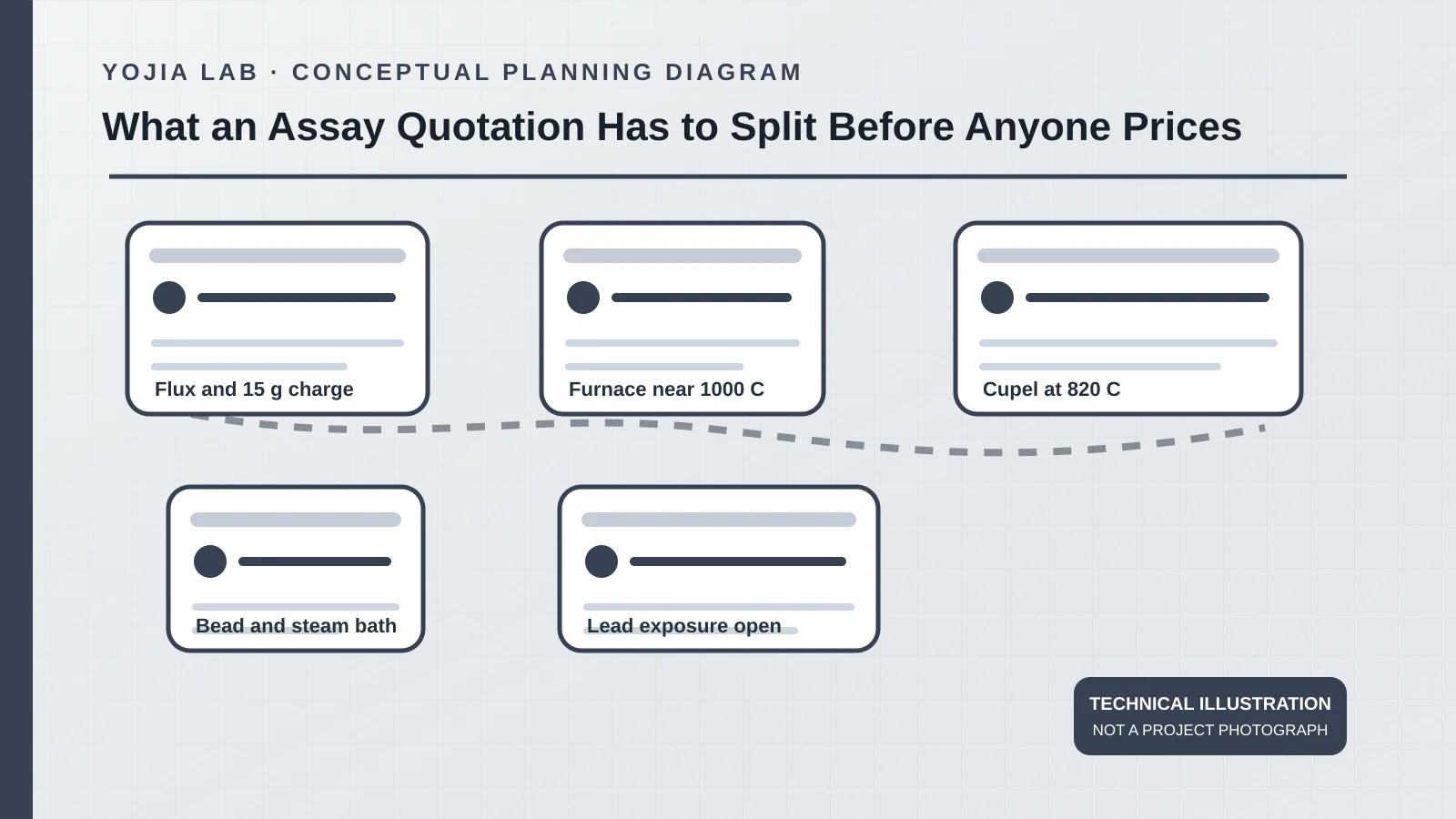
USGS Bulletin 1445 (1977) defines the charge as flux, ore, and any noble metal added. The dry reagents are sodium carbonate, litharge (PbO), silica, borax glass, and calcium fluoride, with flour or potassium nitrate. Litharge melts at 883 °C, and if silica is short the bulletin says lead oxide can eat through the crucible wall. The crucible is a consumable, not a bench. One flux for a 15 g sample of basic or ultrabasic rock is 30 g sodium carbonate, 35 g litharge, 4 g silica, 35 g borax, 1 g calcium fluoride, and 3.2 g flour, with silica varied from 4 to 8 g. A worked example assumes reducing power 5.00, subtracts a 30 g button from 75 g of lead, and divides 45 g by 4.2 to get 10.7 g of niter. That is the example, not a recipe for every ore.
The bulletin will not start the fusion until the ore is judged. A spectrographic scan and a coarse mineral look decide whether it is neutral, reducing, or oxidizing. Reducing power is the lead produced by 1 g of ore fused with excess litharge. Until that test exists, a furniture request cannot state the flux mass, the button size, or how many crucibles a furnace will see. The 1998 USGS booklet Gold, by Kirkemo, Newman, and Ashley, puts the same family of work in one sentence: pulverized sample, lead oxide, soda, borax, silica, flour or potassium nitrate, and silver as a lead-silver alloy, fused at 1000 °C. The booklet is a public explanation, not the 1977 procedure. It can identify the furnace. It cannot copy 1000 °C onto every later step.
02
Three hot steps do not share one temperature
The hot steps do not share a setpoint. Scorification in Bulletin 1445 preheats the furnace to 1000 °C, then lowers it to 950 °C. The 1977 text specifies tongs and asbestos gloves. Asbestos is what that page printed, not a glove to buy now; the request should ask for the laboratory’s current hand protection. Gold cupellation follows the platinum-metal technique except that it drops to 820 °C and finishes at 880 °C. Two milligrams of silver alloyed with lead go into the crucible first, and the silver-to-gold ratio should exceed 3:1 or the bead may resist aqua regia. The atomic-absorption method states gold as low as 50 ppb on a 15 g sample, and the silver difference method as reliable to about 20 ppm. Those limits belong to the 1977 method, not to a purchased bench.
A 15 g fire-assay portion and a 1 g acid digestion are both in the bulletin, and they are not the same surface. The silver method that skips fire assay uses 1 g of rock powder, 10 mL of concentrated nitric acid, a 100 mL beaker, about 15 minutes of gentle boiling under a watch glass, and a further steam bath. Palladium, platinum, and rhodium are preconcentrated from 15 g in a “30 g” fireclay crucible. The gold bead is later opened in aqua regia, often overnight at room temperature and then on a steam bath. The request has to name which method the furnished room will run. A balance support is not a furnace, and a furnace is not that steam bath.
03
After the bead, the work is acid and a solvent
The 1977 gold procedure puts the bead in a 50 mL beaker with 5 mL of 1:1 nitric acid for 30 minutes on a steam bath. Concentrated hydrochloric acid follows until the solution is pale yellow, about 30 to 60 minutes. Then 48% hydrobromic acid and 10 mL of methyl isobutyl ketone are added, the tube is shaken for 1 minute, and gold is read in the organic phase at 242.8 nm. The 1998 booklet stops earlier: a bone-ash cupel absorbs lead oxide, the bead is dissolved in acid, and the reading is usually atomic absorption. Acid comes after the furnace in both documents. The quotation needs the number of beaker positions, whether a steam bath is in the room, and whether the ketone is used.
Drawing the furnace and the solvent step together hides two failures. The furnace handles litharge, crucibles, and temperatures of several hundred degrees. The later bench handles nitric acid, hydrochloric acid, hydrobromic acid, and a ketone. Bulletin 1445 already separates them by procedure. A distributor or contractor can price a support, a cabinet, or a fixture only after the laboratory says which procedure’s vessels will sit there and which of them contain organic solvent. A line that says only “assay benches” asks the price to invent that split.
04
Lead rooms appear only after an exposure number
Litharge is an inorganic lead compound, and 29 CFR 1910.1025 covers metallic lead, all inorganic lead compounds, and organic lead soaps in US general industry. It does not cover construction or agricultural operations under 29 CFR part 1928. The permissible limit is 50 µg/m³ averaged over 8 hours. The action level is 30 µg/m³, without regard to respirators. Paragraph (i) requires change rooms, showers, and lunchrooms only where airborne exposure is above the permissible limit. Change rooms separate work clothes from street clothes. Lunchrooms need temperature-controlled, positive-pressure, filtered air. Food, drink, tobacco, and cosmetics stay out of areas above the limit except in those rooms. Furniture on an order does not create that exposure result.
The request therefore keeps a line open. Has an 8-hour measurement for fusion and cupellation already been made, and is it above 50 µg/m³? If not, the hygiene rooms are not yet furniture scope, and drawing them as certain would invent an exposure. If it is above the limit, those rooms are employer duties under that US rule, and they are still not benches. A cabinet does not establish the 50 µg/m³ figure. The rule is also not a world code. A laboratory outside US general industry names its own lead rule instead of pasting paragraph (i) onto the drawing. What can be priced is the list of work positions left after the furnace, the bead bench, and any required hygiene rooms are separate lines.
Before pricing, check the laboratory furniture support for distributors and contractors against the room and workflow conditions already recorded above.