01
Separate the digestion heat from the bench adjective
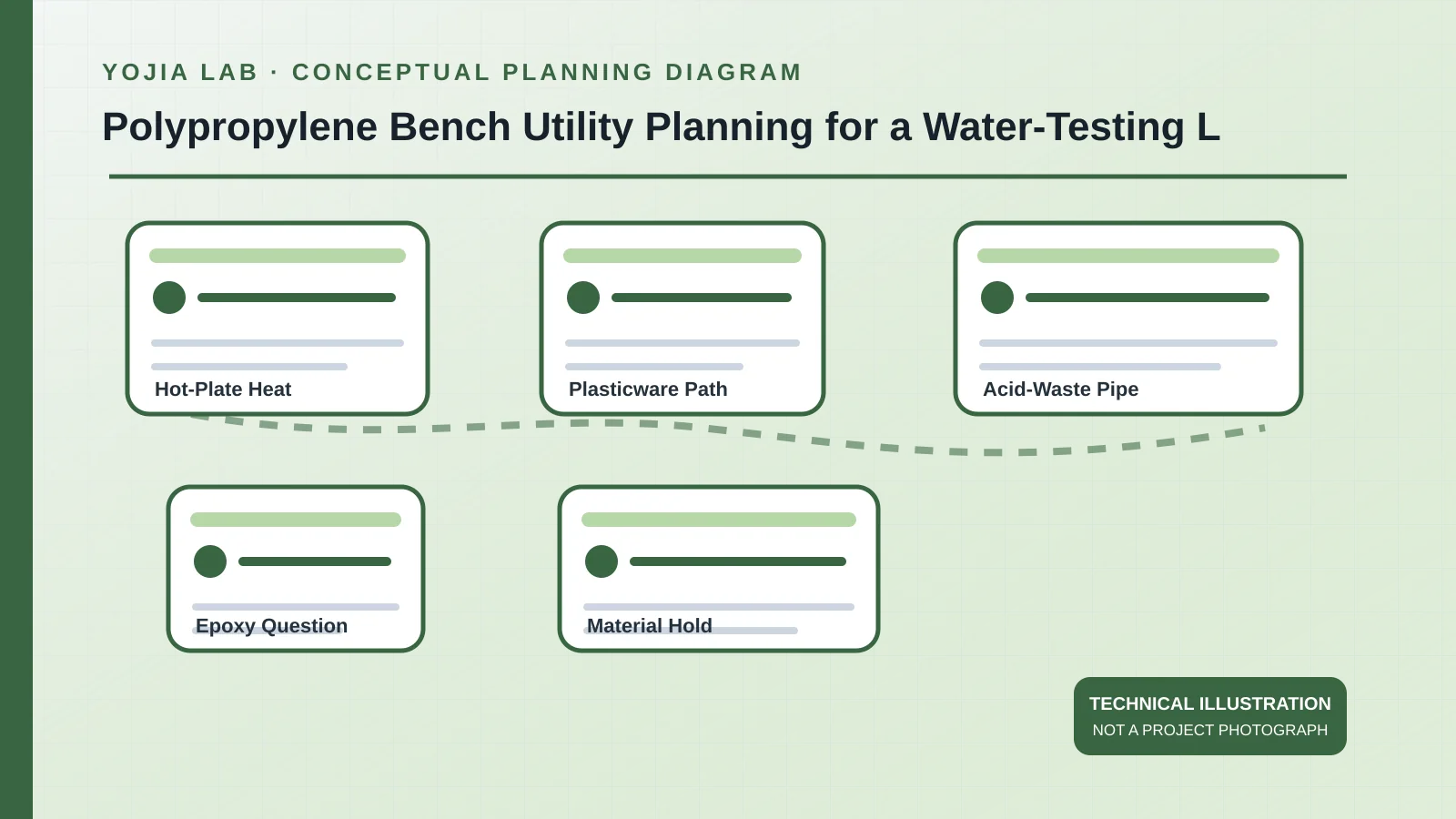
EPA Method 200.7 tells the analyst to reduce an aqueous aliquot by gentle heating at about 85°C and not to boil it, then to reflux under a watch glass. An uncovered beaker of water is the hot-plate check: the water stays at or below about 85°C and rises to about 95°C once covered. A block digester held near 95°C may be substituted. Concentrated nitric and hydrochloric acids belong in a fume hood whenever possible, and so does acidifying a reactive sample, because cyanide or sulfide gas may be released.
None of those sentences names a countertop. A polymer bench under that hot plate is a separate question: the method's temperature is a procedure control, not a furniture rating. Ask the material supplier for the heat limit that applies to the actual resin, thickness, and edge, and ask the engineer where the hot plate sits relative to the hood. Service fixtures can mark water and gas. They do not decide whether the top survives the plate.
02
Follow the plasticware rule only as far as the method goes
Method 200.7 is specific about contamination, not about furniture. For boron and silica in water, only plastic, PTFE, or quartz labware should be used from collection through analysis. Boron in solids is narrower: quartz or PTFE beakers for the extraction, then a prompt move into a plastic centrifuge tube. Avoid borosilicate glass where it would contaminate those analytes. Many standards are stored in FEP bottles, and the labware list also includes polyethylene and PTFE alongside glass and quartz.
That list is a reason to give plastic bottles, funnels, and wash bottles a clean path and a labeled shelf. It is not a reason to specify every cabinet in polypropylene. A glass volumetric flask may still be correct for another analyte in the same room. Write the labware rule on the method row, then ask which surfaces the acidic plasticware actually touches. A polypropylene laboratory bench is in scope only for those touches, and only after the heat and solvent rows are filled.
03
Treat the waste pipe as a piping specification
University of Michigan's piping guideline, written for its own buildings, says most of its chemistry and biology laboratories prohibit dumping acids. Waste is expected to be diluted and within sewer limits, and neutralization is often not required, but the design team must confirm that with the university's design manager. Where a lab-waste system is used, above-ground pipe is typically corrosion-resistant polypropylene, Schedule 40, with mechanical or fused joints. Underground pipe is polypropylene, Schedule 80, fused. Sink traps match the pipe and use mechanical fittings. High-temperature waste is called out for another material, such as high-silicon cast iron or glass.
Copying a Schedule 40 note onto another city's drawing does not make it that city's rule. The guideline also keeps polypropylene pipe inside the manufacturer's temperature and pressure limits, and it fire-wraps pipe in a return-air plenum. Put those limits on the sink row. A polymer cabinet and a polymer drain can fail differently, so the pipe schedule is not proof that the bench is suitable.
04
Ask the casework guide which top it would actually allow
The same university's casework guideline tells designers to check countertop compatibility against the chemicals in use. Where chemical resistance and heat resistance are both needed, it specifies epoxy resin, with a minimum thickness, an overhang, and a drip edge. Solid phenolic is for a lower chemical-resistance need, or for weight and site cutting. Stainless steel is tied to seamless radioactive or surgical work. Acid-resistant plastic laminate is limited to dry rooms without sinks or chemical use. Other tops need the design manager's approval. Toxic and corrosive liquids are not stored above the benchtop.
Polypropylene does not appear on that countertop list. National Academies' Prudent Practices says polypropylene or stainless steel may be preferable in a clean room, and, separately, that some casework materials do not hold up to intensive chemistry. A water-testing digestion bench is not a clean room, and a clean-room note is not a digestion approval. If the project needs heat plus broad chemical resistance, the open question is why a polymer top is proposed and who holds the compatibility note.
05
Hold the bench schedule until the hygiene plan can use it
OSHA's laboratory standard requires the employer to keep a written chemical hygiene plan for the hazardous chemicals in use, including the procedures and protective measures. The word polypropylene does not satisfy that duty. Before fabrication, the package should show the method, the hot-plate set-point, the labware that must not be glass, the sink duty, the pipe material and its temperature limit, and any exposure still unmarked.
Acid working stock and the waste carboy sit beside the bench and do not decide the bench. If a later method adds hydrofluoric acid, a solvent wipe, or a hotter block, reopen the material row. Polypropylene laboratory furniture can then be compared on dimensions, joints, and written limits. That comparison does not mean the furniture suits every acid here, and this diagram is not an installed bench.
Where the storage duty is considering a polymer cabinet or bench, review polypropylene laboratory furniture on its own. A material name does not show that it fits the chemicals, cleaning method, or fire requirements.