01
Name four states before counting cabinets
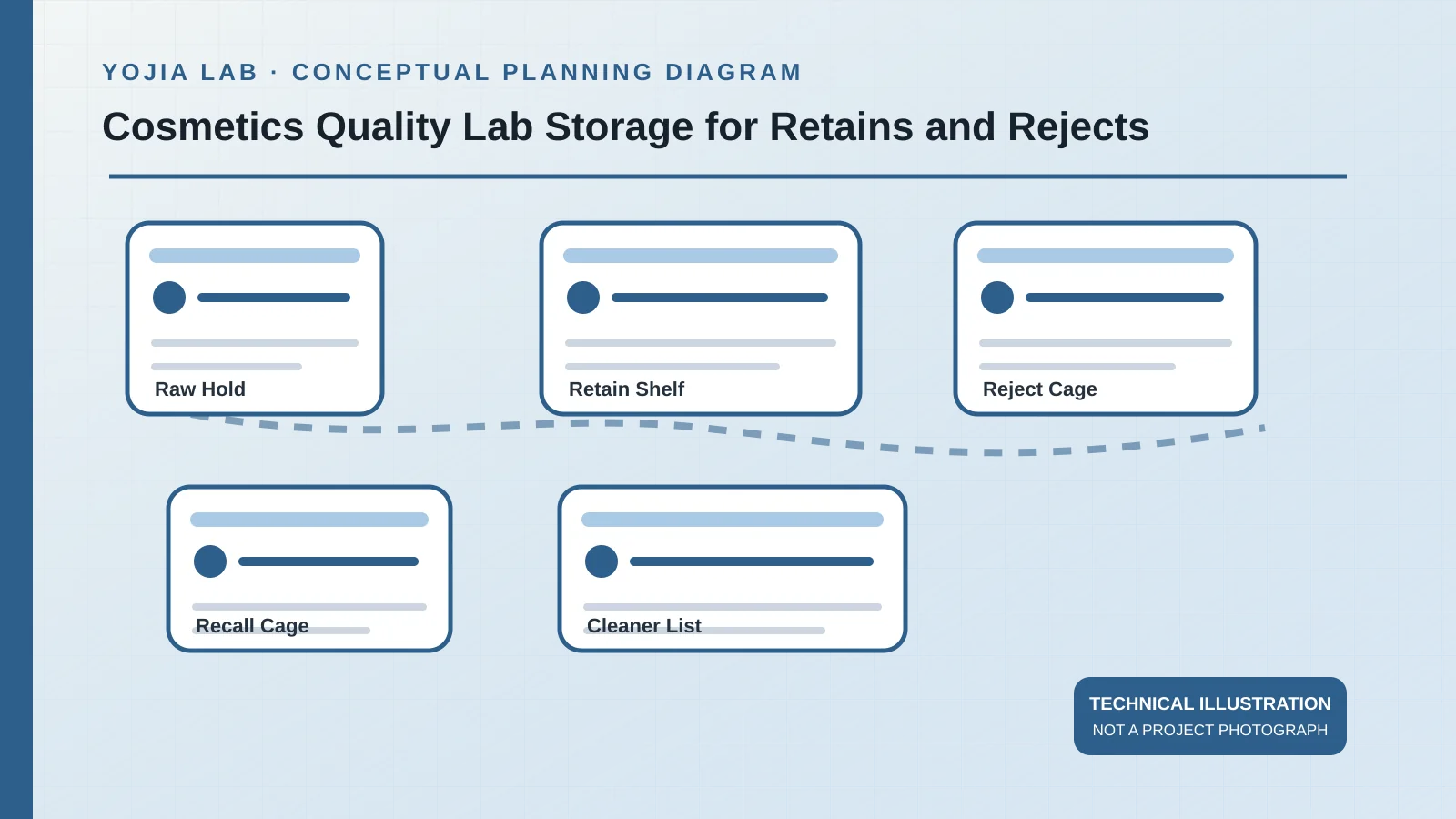
A cosmetics quality room often holds four populations that look alike and behave differently. Unreleased raw material must not be mistaken for stock production may use. Retains exist so an approved lot can be retested. Failed lots have to be blocked. Recalled goods sit apart until someone with authority decides what happens next. FDA’s checklist asks that material missing its specification be controlled so it is not used, and that reserve samples of approved lots be protected from contamination. One cupboard labeled “lab” does not record those differences.
The 2013 draft guidance, which FDA calls recommendations unless it cites a regulation, repeats the split. Approved samples are retained for an adequate time. Returned cosmetics are examined for deterioration. Bagged stock stays off the floor, and containers carry identity, lot, and control status. Those are labels and locations, not a count of doors. Draw four addresses first, even if two later share a room. A drawing that only says “chemical storage” has not started.
02
Protect the retain from the hold that is still undecided
FDA asks that retains avoid contamination and deterioration, and that finished-product samples and retains be checked for whether preservation still works. The guidance prints neither a universal number of months nor a universal temperature. Copy both from the firm’s specification. If that note is missing, the shelf stays an open question, not a default refrigerator. The coldest cabinet can be the wrong protection when the specification expected ambient storage and the cabinet also holds something that leaks.
Water used as a cosmetic ingredient has its own story in the same guidance: defined quality, monitoring, and a supply laid out to avoid stagnation. Bottles from that monitoring are not jars of finished cream. Give them a labeled place if they are kept. Prudent Practices notes that even closed containers can release vapors that attack labels and neighboring containers. A retain whose label has been ruined is no longer identifiable.
03
Park failures, recalls, and restricted ingredients apart
The guidance points voluntary recalls toward 21 CFR part 7 and asks that recalled units be identified and kept secure until disposition matches the risk. That place is not the retain shelf and not the shelf of material still awaiting a result. Security here means access and a status label the laboratory defines, not a claim that a lock is certified. Failed lots need their own address because material that misses its specification must not be picked up for production. A red tag in a mixed cabinet is weaker than a bay people do not open when they are looking for a retain.
FDA’s guidance lists prohibited or restricted cosmetic ingredients, including chloroform under 21 CFR 700.18, methylene chloride under 21 CFR 700.19, mercury compounds under 21 CFR 700.13, and hexachlorophene under 21 CFR 250.250. Containers held for identification of those substances should not sit on the retain shelf of ordinary approved lots. Prudent Practices sorts chemicals into 11 storage groups, separated by a tray or by a cabinet of their own. Group B, pyrophoric and water-reactive chemicals, and group X, incompatible with every other group, need the strictest split. Ask the question even when most retains will not fall into those groups.
04
Ask whether polypropylene is even the right question
Construction material becomes a line only after a state has an address. Prudent Practices puts volatile toxic or odor-producing chemicals in a ventilated cabinet and asks shelves to have a lip. A closed polypropylene cabinet can give a compatible group its own box. It is not a ventilated cabinet, and it is not evidence that the polymer resists the mixture. A plastic tray is the other separation the National Academies describe. Write which one is needed, and for which group.
OSHA’s laboratory standard leaves the chemical hygiene plan, including exposure controls where they are needed, with the employer. A furniture elevation does not replace that plan, and a resin name does not record compatibility or fire behavior. List the cleaners and ingredients the surface will meet, and leave the material line open until that list is compared with the construction on offer. FDA says it reviewed ISO 22716:2007 and then kept, changed, or omitted parts. This drawing is not a certificate against that document.
05
Leave the blanks that a catalog cannot close
FDA’s checklist wants orderly storage, closed containers, and bagged stock off the floor. Those sentences can be drawn: a shelf that keeps sacks off the slab, a label for identity, lot, and control status, and a path that does not cross the recall cage to reach a retain. They cannot be drawn as one tall unit whose tape colors are expected to do the rest. If the retain period is still the word “adequate,” print that word as an open field. Do not convert it into a number borrowed from another industry.
A sheet ready for a factory should show the four states, the conditions copied from the specification, any ventilated cabinet the chemical review actually asked for, and the groups that must not share a tray. Polypropylene can appear as a candidate for a closed, non-ventilated group. It should not be the default for the whole room. A blank filled with a material adjective is harder to see than a blank left empty.
Where the storage duty is considering a polymer cabinet or bench, review PP laboratory furniture on its own. A material name does not show that it fits the chemicals, cleaning method, or fire requirements.