01
Give soil bags a different shelf from reagents
The methods manual ships mixed soil in plastic bags, clods in cardboard boxes, and biological material double-bagged so it does not dry out, while remaining permeable enough to oxygen and carbon dioxide that aerobic samples stay aerobic in transit. Water samples are a third object: the manual says not to freeze them, because freezing can change pH and pull dissolved organic matter out of solution. None of that is a chemical cabinet. A room that piles moist bags above hydrochloric acid has merged custody with reagents.
NRCS's soil-survey safety guide wants an inventory, clear labels, and no food or drink beside chemicals. It also bars floor storage even for a moment, storage on top of cabinets, storage above eye level, and storage on benches or in chemical hoods except while in use. Give sample bags a labeled rack that is not the acid cabinet and not a staff food refrigerator. A soil bag does not make that refrigerator acceptable.
02
Split acids, and do not let nitric acid share by default
The safety guide’s storage rules sort by compatibility, not by the alphabet. Organic and inorganic chemicals are separated first. Among inorganic families, acids are their own group, and nitric acid is called out: store it alone unless the cabinet has a separate compartment for it. Volatile and odorous chemicals go in a ventilated cabinet. Flammable liquids go in an approved flammable cabinet. Water-sensitive chemicals go in a water-tight cabinet, cool and dry, away from the others. A single polypropylene cabinet with one shelf label cannot be all of those families.
The Kellogg field coatings use acetone and saran resin, kept as a lacquer in covered plastic or steel containers, plus hydrochloric acid supplied already diluted, with a safety data sheet to read. Acetone does not join the acid cabinet because one method uses both. NIH's March 2025 sheet, for NIH laboratories, says corrosive cabinets and flammable cabinets are class-specific, not general storage. Strong acids and bases are separate cabinets when quantity and space allow. If non-working Class 1, 2, or 3 flammables exceed the 500 milliliter or 500 gram line on that sheet, it sends them to an approved flammable cabinet. That threshold is NIH's. Record the threshold this project uses. A polymer box does not meet it by assumption.
03
Read the bottle warning before naming polypropylene
Part 1 of SSIR 42 is blunt about water-sample containers. Polyethylene can increase chlorine over time or adsorb organic material, and the error grows with a more permeable container. Glass can release sodium and silicon. A small volume in a large bottle has more wall contact. Containers are acid-washed and capped before they go to the field. Those sentences do not rate a cabinet. They do show that the Kellogg authors refuse to treat “plastic” as inert. A furniture schedule that says polypropylene, with no chemical list beside it, is less specific than the bottle note they already require.
University of Illinois research safety makes the same point for containers and then for cabinets. Some chlorinated solvents degrade plastics. Hydroxide solutions dissolve aluminum and etch glass. Hydrofluoric acid dissolves glass. Cabinets should be chemically resistant and labeled for acids, bases, or flammables, with ventilation recommended for corrosives and malodorous chemicals. Hazardous stock should not sit above six feet, benchtop storage is discouraged, and under-sink space is for non-hazardous items. Six feet and the soil-survey eye-level line are different rules. Print the one this room must follow. Ordering polypropylene laboratory furniture proves neither.
04
Keep the tray example from becoming the cabinet
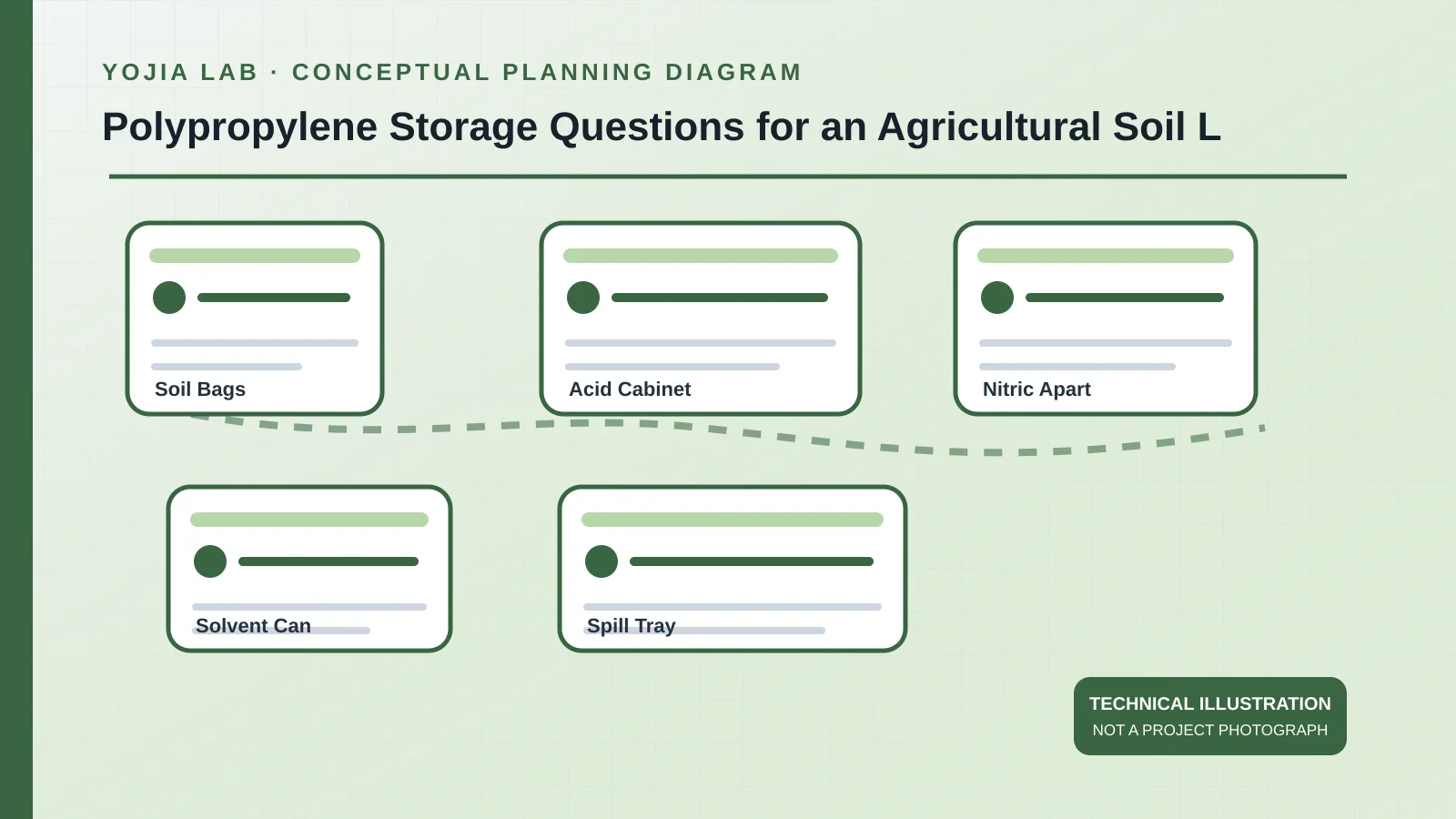
NIH's sheet lets secondary containment separate hazard classes and catch drips. The material should be non-reactive. The examples are Nalgene, polypropylene plastic, or an equivalent, labeled with the hazard class inside. Hazardous chemicals stay at or below eye level and out from under the sink. Two pictograms are stored for the more severe hazard. The polypropylene named there is a tray or tub. It is not a license to build every soil-lab cabinet from that polymer, and it is not a test report.
Illinois adds segregation a tray cannot replace. Oxidizing acids, including nitric, perchloric, and sulfuric acids, stay apart from organic acids. Corrosives stay away from gas cylinders and instruments. Water-reactive chemicals stay away from sinks, eyewash stations, and showers. The safety data sheet identifies incompatibilities. A polypropylene spill tray can still be the right object when that example fits. A polypropylene cupboard for acetone, nitric acid, and moist soil bags does not become correct because the tray used the same word.
05
Leave compatibility blank until the sheets are attached
The schedule can be short. One row for field bags and clods. One for water samples that must not freeze. One for dilute hydrochloric acid. One for nitric acid if the method list includes it. One for acetone and other flammables, pointing at an approved cabinet or a blank. One for anything proposed in polypropylene, with the safety data sheets named. NRCS wants shelves secured, lockable doors, a front lip it recommends at about three-quarters of an inch, and ventilation. Those are questions, not demonstrated features.
No row should say the polymer is suitable for soil extracts, acids, or solvents in general. Illinois’s examples show plastics failing some solvents and glass failing hydrofluoric acid. The Kellogg bottle note shows polyethylene changing a chlorine result. NIH limits its polypropylene example to non-reactive secondary containment. Until the project’s own sheets and the cabinet maker’s data are clipped to the row, the material cell stays empty. The drawing can still reserve space, locks, and a lip. It cannot reserve a compatibility claim.
Where the storage duty is considering a polymer cabinet or bench, review PP laboratory furniture on its own. A material name does not show that it fits the chemicals, cleaning method, or fire requirements.