01
The temperatures in the 2018 chapter are appliances
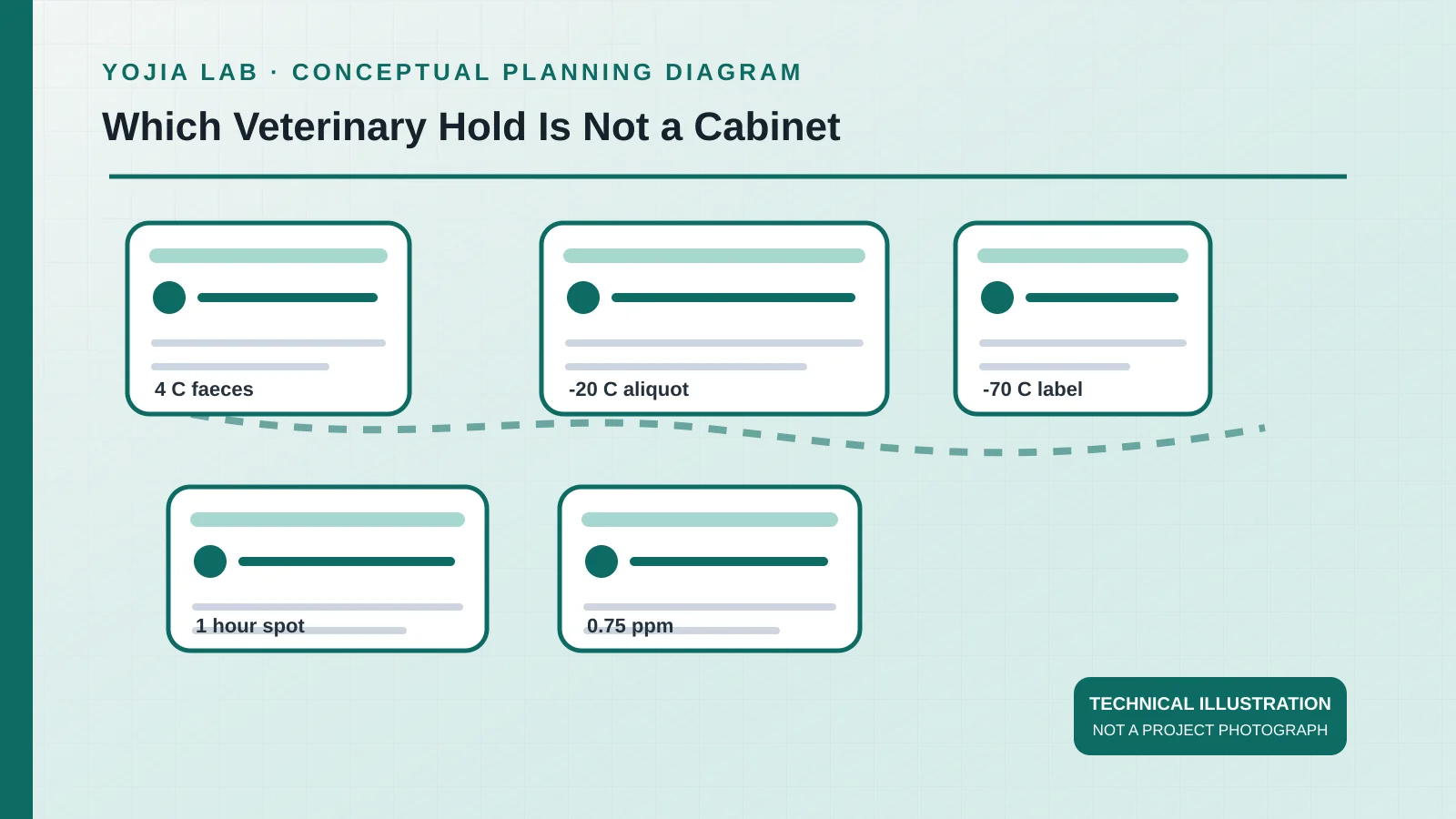
Chapter 1.1.2 keeps faeces chilled, at 4 °C or on ice, and says to test as soon as possible. Blood and sera travel cool, sera frozen, in non-breakable vials. The receiving room gets cleanable surfaces, a biosafety cabinet only where the risk assessment requires one, and refrigerator or freezer space for the wait. None of that is a cabinet count.
Ultra-low storage, liquid nitrogen or cryopreservation at −140 °C or lower, is called the optimum for long-term biological material. Holds at −80 °C and −20 °C are called common for periods that may run from months to 5–10 years, with a higher degradation risk in the warmer freezer and a cost warning on the ultra-low option. Material opened often is split into aliquots. Repeated freeze-thaw is avoided. Unique isolates use at least two procedures and two places. Those are freezer and tank decisions. A polypropylene cabinet is not on the list.
02
Room temperature is a short list, not a default cupboard
The chapter does name freezer-free options: commercial nucleic-acid stabilisers, lyophilisation, drying onto filter paper, and a desiccant such as silica gel or rice grains. A filter card is not a licence to cupboard every leftover reagent. Cold storage remains the receiving-room default for specimens that are still waiting. A room-temperature address exists only for the stabiliser the file has named. Serum or faeces without that choice stays cold.
One sentence is easy to misread as a plastics approval. Marks must survive wet and frozen conditions, pencil may rub off, and labels stuck to plastic may fall off at −70 °C. That is an identity warning at a stated temperature. It is not a resin test, and it does not make an ordinary sticker on a polymer door into an archive label. The −70 °C freezer, and the −80 °C hold printed beside it, need a mark the laboratory has shown will stay on. The cabinet question has not started.
03
Formalin is an air limit where the U.S. rule applies
Post-mortem tissue here is most often placed in formalin, and staff who receive it are trained on hazards and transport. The chapter names no resin. Where 29 CFR 1910.1048 applies, the action level is 0.5 ppm and the permissible limit is 0.75 ppm, both eight-hour averages, with a 2 ppm short-term limit over 15 minutes. At 95 percent confidence, monitoring is to fall within ±25 percent at those two limits and within ±35 percent at the action level. A laboratory outside that U.S. rule does not inherit the figures by analogy.
A polypropylene cabinet does not record a breathing-zone result. Boxing the stock does not show the air is under 0.75 ppm, and a reading of 0.4 ppm does not show the box survived the solution. Training, and monitoring where the section applies, stay on their own rows. The cabinet row opens only after the container is ruled out of the refrigerator, the −20 °C freezer, the −80 °C freezer, and the liquid-nitrogen vessel.
04
The one-hour spot test is not that air result
SEFA 8P-2026 is an association standard for laboratory-grade polypropylene casework, not a veterinary regulation. The spot test uses a 14 by 24 inch panel, conditioned 48 hours at 73 ± 3 °F (23 ± 2 °C) and 50 ± 5 percent relative humidity, or the ASTM condition that sentence allows. Forty-nine reagents stay in contact for one hour: volatile reagents in an inverted 1-ounce bottle on a saturated cotton ball, others as five drops under a 24 mm watch glass. Scoring is 24 hours later. Level 3 is pitting, cratering, swelling, erosion, or obvious deterioration, and a laboratory-grade finish is not to show it. Results vary by manufacturer. Section 8.1.4 says the longer charts come from resin makers, mark a highest “recommended” temperature, and leave the decision to the user.
The shelf procedure, unless otherwise specified, loads 10 pounds per square foot up to 75 pounds and notes that a longer shelf supports less. That is a test load, not the mass of serum racks, and not a reason to drop the freezer. A polypropylene cabinet can be priced only for a named room-temperature duty the 2018 chapter has not already given to an appliance. The spot test, the shelf load, and the parts-per-million limits answer different questions. Filling one blank with another is how a polymer name gets mistaken for a specimen address.
Where the storage duty is considering a polymer cabinet or bench, review polypropylene laboratory furniture on its own. A material name does not show that it fits the chemicals, cleaning method, or fire requirements.