01
A fire cabinet is a fire test, not a resin name
29 CFR 1910.106 covers flammable liquids with a flash point at or below 199.4 °F (93 °C), aside from exclusions in paragraph (j). Category 1 is below 73.4 °F (23 °C) and boils at or below 95 °F (35 °C). Category 2 keeps that flash point and boils above 95 °F. Category 3 runs to 140 °F (60 °C), and Category 4 to 199.4 °F (93 °C). Paragraph (d) covers containers up to 60 gallons and portable tanks up to 660 gallons. Its exceptions name bulk plants, service stations, refineries, chemical plants, and distilleries. Testing labs are not on that list.
A storage cabinet may hold not more than 60 gallons of Category 1, 2, or 3 liquid, and not more than 120 gallons of Category 4. It must limit the interior to not more than 325 °F in a 10-minute fire test on the NFPA 251-1969 curve, with joints tight and the door closed, and the label reads Flammable—Keep Fire Away. Metal cabinets of at least No. 18 gauge sheet iron, double walled with a 1 1/2 inch air space, a three-point lock, and a sill at least 2 inches high, are deemed to comply. A polypropylene box is not that example, and a resin chart does not report the fire test.
02
Corrosive cabinets are a different job
The NIH Division of Safety fact sheet revised in March 2025 says corrosive cabinets and flammable cabinets are for particular hazard classes, not general storage. Large amounts of strong acids and bases go in separate cabinets when space allows. Small amounts may share a cabinet in secondary containment on separate shelves. Organic acids stay apart from inorganic acids, and organic bases from inorganic bases. Doors stay closed. A chemical that is both flammable and corrosive is stored for the more severe hazard. The sheet's example is a flammable cabinet plus separate secondary containment.
Secondary containment, the sheet says, should be non-reactive. Its examples are Nalgene, polypropylene plastic, or an equivalent, labelled with the hazard class. That sentence is about a tray. It is not a fire rating and not a finding that a cabinet wall survives every acid. Chemicals stay at or below eye level and out from under the sink. NIH Design Requirements Manual Revision 2.1 (2 August 2024), section 4.5.3.2, puts a flammable cabinet in every NIH wet lab and keeps it out from under a fume hood, away from a door, a desk, and a busy aisle. Another lab uses that placement only when its specification adopts it.
03
Read the coupon before naming polypropylene
HMC Polymers reports resistance for its polypropylene resins under ASTM D543. Specimens are unstressed dumbbells, 76 mm long and 0.635 mm thick, read after one month of immersion. The guide calls many ratings only an indication, because a lab immersion is not service. In most aqueous environments the weight gain is under 0.2 percent after six months at ambient temperature, and under 0.5 percent at 60 °C for a similar period. The 24-hour water absorption cited to ASTM D570 is 0.03 percent. Those figures describe the coupons, not a door, a hinge, a seal, or a loaded shelf.
The same guide says the resins are appreciably affected by chlorosulfonic acid and oleum at room temperature; by 98 percent sulfuric acid, 30 percent hydrochloric acid, and 30 percent hydrogen peroxide at 100 °C; by 98 percent sulfuric acid at 60 °C; and by fuming nitric acid and liquid bromine at room temperature. Under strain, strong oxidizing acids can cause failure at lower temperatures. Named stress-cracking cases include 98 percent sulfuric acid, concentrated chromic-sulfuric mixtures, and concentrated hydrochloric acid with chlorine. The attacking condition governs, not the mild aqueous weight gain.
04
A plastic bottle is not a plastic cabinet
Table H-12 limits glass or approved plastic to 1 pint for Category 1, 1 quart for Category 2, and 1 gallon for Categories 3 and 4. A container of no more than 1 gallon may be used for Category 1 or 2 only on the paths the paragraph states: a metal-contact problem plus a process need above 1 pint or 1 quart from one assay lot, an analytical-standard quantity above one-sixteenth of the table allowance, or direct export. Approved plastic is the regulation's phrase. The bottle rule does not qualify a cabinet, and the fire test does not qualify the bottle.
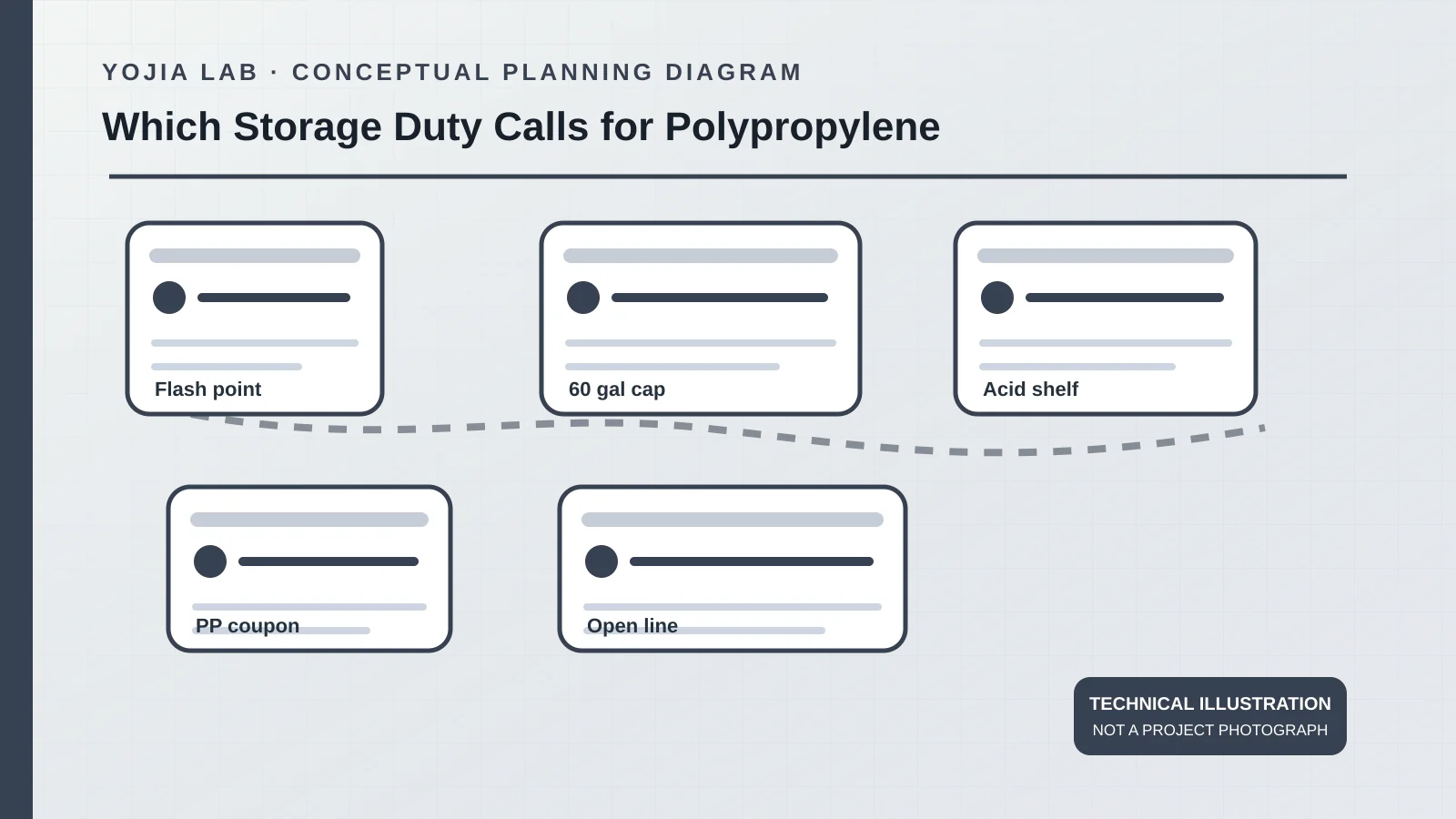
A testing-lab drawing therefore carries three lines. Flammable liquids inside 1910.106 go to a cabinet that meets the fire test and the gallon cap. Corrosives go to a corrosive cabinet or, in small amounts, to secondary containment on separate shelves. Polypropylene is a candidate for that tray, or for a cabinet in a corrosive duty, only when the chemical, concentration, and temperature match a cited test, and the part is not asked to outperform a 0.635 mm coupon. A line reading PP cabinet for acids and solvents joins two tests that the documents keep apart.
Where the storage duty is considering a polymer cabinet or bench, review polypropylene laboratory furniture on its own. A material name does not show that it fits the chemicals, cleaning method, or fire requirements.