01
Keep each duty on its own line
The National Academies' Prudent Practices volume says work surfaces should be chemical resistant, smooth, and easy to clean, and that some materials do not hold up under intensive chemistry. Casework in that chapter should be cleanable, repairable, and movable when the work moves. Fixed items such as sinks tend to stay at the perimeter, while carts take the middle. Those sentences arrange a laboratory. They are not a purchase list, and they do not award the room to one polymer.
A single heading that only says polypropylene furniture flattens duties the sources keep apart. Write one line for clean assembly, one for the general wet bench, one for corrosive storage, and one for any enclosure. A line without a chemical list is still a question. Filling every line with the same material name makes the later comparison impossible, because two bidders will not know which duty they priced.
02
Read the clean-area note apart from the wet-bench note
Ohio State's laboratory design note names polypropylene or stainless steel for clean areas. The next sentence names epoxy resin or phenolic resin for benches that should be chemical resistant, smooth, and easy to clean, and it asks for a seamless top with sealed penetrations. The two sentences aim at different duties. A chemistry research room can hold a clean assembly and a general wet bench on the same afternoon. Copying one sentence onto the other duty is how the wrong surface enters a specification.
Neither sentence is a test report for a product a factory might offer. The chemical list still has to sit beside the material proposed for review, together with the solvent or detergent the group actually wipes with. Stainless steel on the clean-area line is a second candidate the university note already pairs with polypropylene. Naming it does not finish the comparison. It only stops the clean-area line from being treated as already decided.
03
Leave corrosive storage off the work surface
The same Ohio State note says cabinets for non-flammable corrosives should use a corrosive-resistant material such as polypropylene or polyethylene, with a pan of that family on each shelf and at the bottom. Shelves that hold chemicals should have lips. This is a storage duty, not a description of the bench people work on. OSHA's appendix says chemicals should not be stored on the benchtop, the floor, the egress, or in the hood. A polymer cabinet does not make a benchtop an acceptable store.
The cabinet material name still does not show that the box, the pan, and the bottles agree. Write the corrosives the cabinet is allowed to hold, and write what is excluded. A line that says only "polypropylene cabinet" lets two readers imagine two different contents. The chemical hygiene plan required by OSHA's laboratory standard, where hazardous chemicals are used, remains the place for control measures. The furniture line points at the plan. It does not close it.
04
Put a fire question beside any polymer enclosure
Prudent Practices says polypropylene chemical hoods are common in clean rooms and warns that the material burns and melts readily. It discusses a fire-retardant grade or an extinguisher inside the enclosure. That warning is about enclosures, not every polypropylene shelf. If this room is considering a polymer enclosure, the fire review is its own line, with the institution's reviewer named. This page does not choose a grade.
OSHA's laboratory standard also requires the chemical hygiene plan to give additional attention to particularly hazardous substances, including select carcinogens, reproductive toxins, and substances with a high degree of acute toxicity. An enclosure question does not answer that part of the plan. If the group has not yet said whether such substances are in the room, the furniture comparison stays open on that point. Guessing "no" in order to simplify the material line hides a review that still belongs to the laboratory.
05
Stack the comparisons that are still open
Ohio State's note also asks that furniture and equipment leave a path to an exit from any point, and it points to NFPA 45 for that arrangement. It asks furnishings to be easy to clean and repair, with knee space for long procedures and a decision on elbow, foot, or electronic sink controls. Those are arrangement questions. They sit beside the material lines and do not replace them. A clear exit does not identify the wet-bench surface.
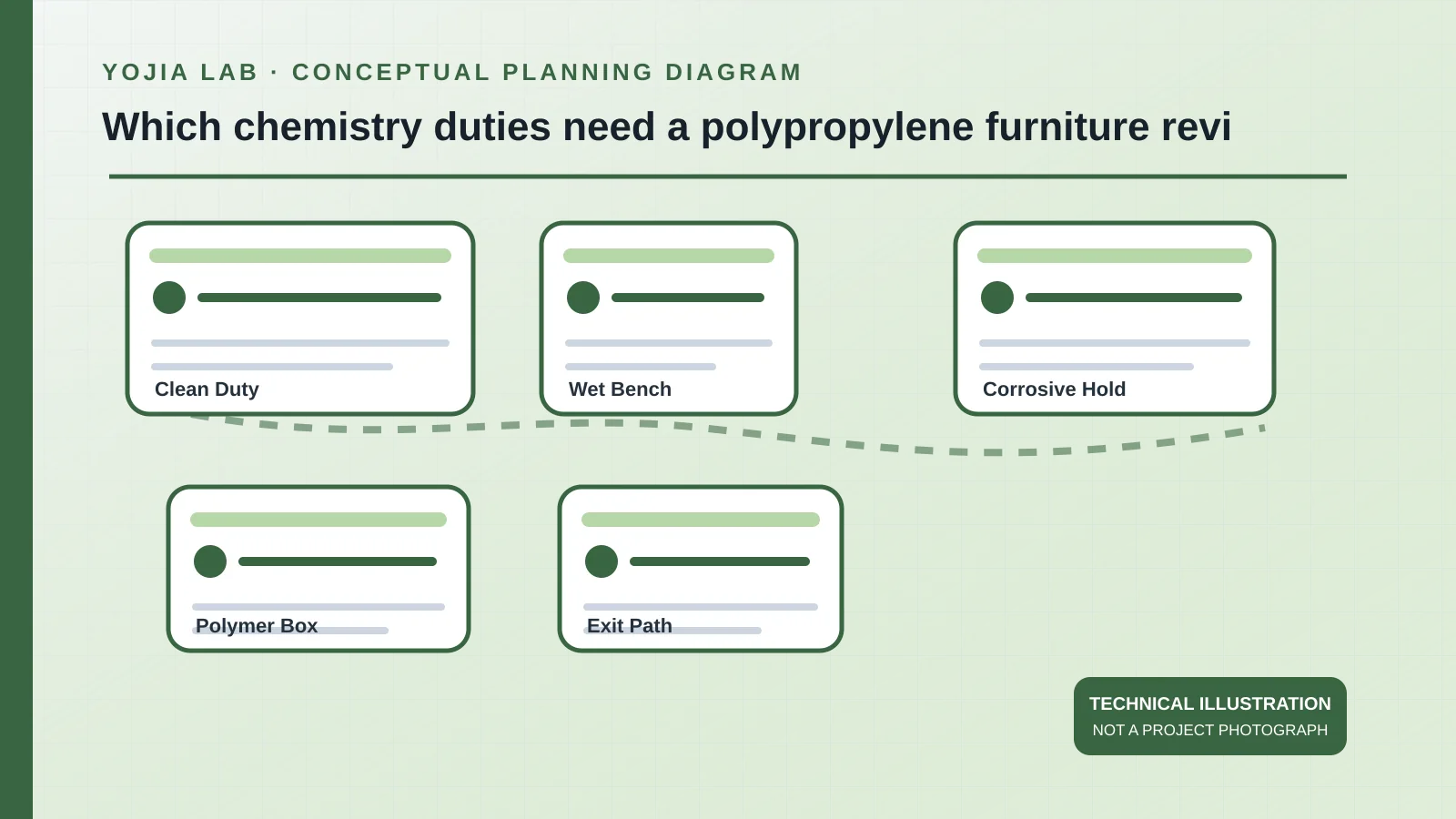
A package two readers can compare names each duty, the chemicals, the wipe-down, the fire review, and the dimensions still unknown. A factory can say which construction it would offer, including where polypropylene is and is not proposed. It cannot supply the chemical list or sign the fire review. The figure shows five reviews as separate zones. It is a diagram, not a photograph and not a material approval.
Selection here is a room configuration, not a generic catalog. Put the dimensions, materials, and interfaces to confirm for the PP laboratory furniture next to what a China laboratory furniture manufacturer can answer from drawings and a written brief.