01
The slab is not the whole room
The October 2025 policy quotes C511 section 4.1: air in the vicinity of the mixing slab, molds, and base plates is maintained at 23.0 ± 4.0 °C and at a relative humidity of not less than 50 percent. The vicinity is the point. A corridor is outside that sentence. Methods that follow both temperature and humidity include C185, C187, C191, C266, C305, C451, and C1437. C1506 follows only the temperature. One printed “laboratory temperature” drops the list.
C109 does not simply cite C511. The policy makes its mixing temperature 23.0 ± 3.0 °C instead of 23.0 ± 4.0 °C, with the same humidity. C227, C441, C1260, C1567, and T 303 use 20 °C to 27.5 °C, again with the C511 humidity. C511-03 section 4.2 sets mixing water for paste and mortar at 23.0 ± 2.0 °C. That water point is a utility at the slab, not a tap assumed from a catalog bench. The 2003 copy says it has been superseded, so the water figure is cited from that edition and the slab air from the 2025 policy.
02
The moist room stays wet on purpose
C511-03 section 5.1 sets a moist cabinet or moist room at 23.0 ± 2.0 °C and not less than 95 percent relative humidity. Stored surfaces must look moist and feel moist. A recording thermometer is compared with a reference readable to 0.5 °C. The door stays closed at least five minutes, the reference stays inside, and it is read as the door opens. A difference above 1 °C means the recorder is adjusted to within 0.5 °C. The 2025 policy, which says it is not a full restatement of C511, adds an ISO/IEC 17025 calibration, a single test point between 21.0 °C and 25.0 °C, and uncertainty not exceeding 0.5 °C.
Minnesota's 2026 study guide, summarizing C511 for curing under ASTM C31, says moist cabinets and rooms use durable materials and tight-fitting doors, with automatic control at 73.5 ± 3.5 °F (23 ± 2.0 °C) and at least 95 percent relative humidity. Specimens are not exposed to dripping or running water. A cupboard that traps a drip, or that blocks the recorder, fights that sentence. The 2025 policy puts the weekly review on the same document as the data, limits a chart to one week, and keeps the record at least three years.
03
The tank is not a cupboard
The 2026 guide's summary of C511 describes tanks as non-corroding, with water held at 73.5 ± 3.5 °F (23 ± 2.0 °C) and the recorder sensor in the water. The water is saturated with calcium hydroxide, stirred at intervals not over one month, and refilled at 3 g/L of calcium hydroxide within 24 months. A corrosive cleaner is excluded. That is the tank to price when the laboratory cures in water. It is not a storage cabinet.
The 2025 policy section 5 lists C31 and C39 among methods that may use either a moist room or a water tank. Section 4 lists C109 for moist cabinets and moist rooms. The study guide says C31 moist-cures standard-strength cylinders in a controlled moist room or a water tank, and receiving ends by placing the cylinder in the moist room or the lime bath until the test date. One shelf for “all samples” skips that choice. Field cylinders and paste cubes do not automatically share one piece of furniture.
04
The machine load is not a bench load
The 2026 guide lists a compression machine at a loading rate of 35 ± 7 psi/sec, plus pads of 50, 60, or 70 durometer. That rate is a machine setting. None of the three documents prints a machine mass, so the quotation asks the maker for the floor reaction and keeps it off the furniture schedule. A kilogram invented from the presence of a cylinder would be an example presented as a measurement.
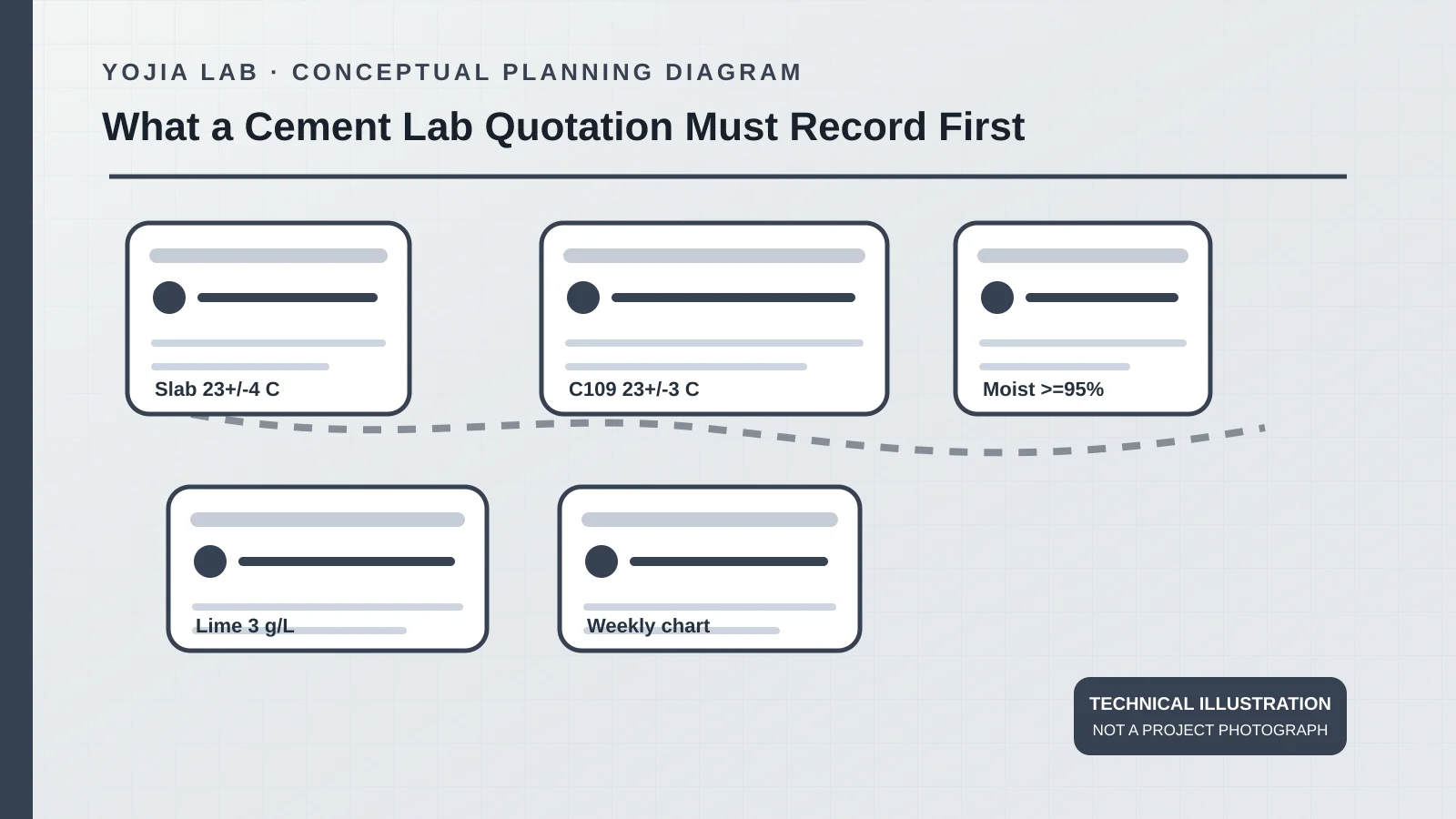
The lines a scope sheet can carry are the slab air at 23.0 ± 4.0 °C and at least 50 percent relative humidity, or 23.0 ± 3.0 °C for C109, plus 2003 mixing water at 23.0 ± 2.0 °C. The moist room is 23.0 ± 2.0 °C and at least 95 percent, with no dripping water and a recorder checked after the door has been shut. The tank is non-corroding, refilled at 3 g/L, with the sensor in the water. One bench description cannot hold the three climates, because they are not one room.
Before pricing, check the distributor and contractor project support against the room and workflow conditions already recorded above.