01
Keep opened salt inside the enclosure the procedure names
The battery-facility hygiene plan at the University of California, Santa Barbara, treats lithium hexafluorophosphate and its sodium analogue as salts that react with moisture and can break down when heated into corrosive products, including hydrogen fluoride. Under that plan the salts stay in a glovebox, an opened bottle is not carried back into the room, and glass is not the storage container. The carbonate solvents used to dissolve the salt are described there as volatile and flammable, and as able to form peroxides after long contact with air. Once opened, they stay with the glovebox too.
That glovebox is a contained argon atmosphere, sometimes nitrogen. It is not a bench. The plan's housekeeping says idle chemicals go back to cabinets or designated rooms, not into hoods as storage, while the salt procedure names the glovebox as the place of work. Sandia's 2013 note for a non-abuse test building draws another line: that building was not the abuse bays, yet the note still lists thermal runaway, fire, electrolyte leakage, and rapid out-gassing as off-normal outcomes. The architecture team owned the design response. The first row exists so neither laboratory's enclosure is copied onto this room.
02
Give the test chamber its own limits
A 2019 Idaho National Laboratory perspective in the Journal of The Electrochemical Society separates training documents from a test plan. The plan covers how a cell is exercised, including voltage, current, and temperature limits, plus hazards the training note omits. For cells at or above one ampere-hour, the authors want review by the facility manager, the investigator, and the operator. They treat an environmental chamber as the usual place for the run, because temperature drives both the data and the hazard. If flammable gas is expected, they say extra ventilation should be considered.
The same paper describes a chamber event and the loading limit that laboratory adopted afterward. That limit is their practice, not a figure for this drawing and not a property of a bench. Cables, terminal covers, and the chamber belong to the test plan, not to the finish on a wet surface. This project's cell inventory stays blank until its own safety basis fills it.
03
Ask about polypropylene only on the wet-contact row
Stanford's design guideline says work surfaces must be impervious to the chemicals used, with a lip so a spill is less likely to reach the floor. It rejects unfinished wood because wood absorbs liquid and burns readily, and fiberglass because disinfectants can degrade it and because it can smoke toxically in a fire. Stanford extends that reading to chemistry and electronics rooms. The paragraph names no replacement. Polypropylene is only a name a project may propose. It is not what Stanford wrote.
A polymer bench does not enter the glovebox or the chamber. Polypropylene laboratory furniture is in scope only where someone claims an open surface or a cabinet will be wetted, wiped, or asked to hold a spill. Stainless steel can sit on the same row as a comparison, with the same unfinished question. Write the contact, the temperature, and the cleaner beside the name. A catalog adjective is not the imperviousness Stanford asked for. Fire behavior of the polymer stays with the fire reviewer.
- Chemicals that will actually touch the surface
- Heat at that surface, including any hot plate
- Cleaners and disinfectants the room will use
- The fire reviewer's question, left open
04
Do not promote a waste jar into a bench specification
The Santa Barbara plan says waste that mixes the salt with carbonate solvent can be both flammable and corrosive. It tells that facility to use a plastic container rather than glass, and it prints small quantities and a short hold. Those numbers are that facility's procedure, not a capacity or a lead time here. A waste row still has to name the container, what must not be mixed, and who removes it. A plastic jar is not a bench.
Reading the jar sentence as approval of polypropylene casework skips the difference between a waste vessel and a work surface. The bench still has to face Stanford's test against the chemicals used, including anything that splashes when the jar is filled. If the waste hold later moves into a cabinet, that cabinet gets its own row. Ventilation and fire separation stay unmarked until the reviewers mark them. A cup sink or a gas turret does not choose the polymer.
05
Release utilities only when the three zones are named
Pricing can start only when three zones have owners. The enclosure needs an atmosphere, an alarm contact, and a rule for opened bottles. The test position needs a plan, a chamber or a reason not to use one, and cable strain called out. The wet-contact row either says no open surface sees these chemicals, or it names the material, polypropylene or another, beside the safety data. A furniture release cannot do the design team's job.
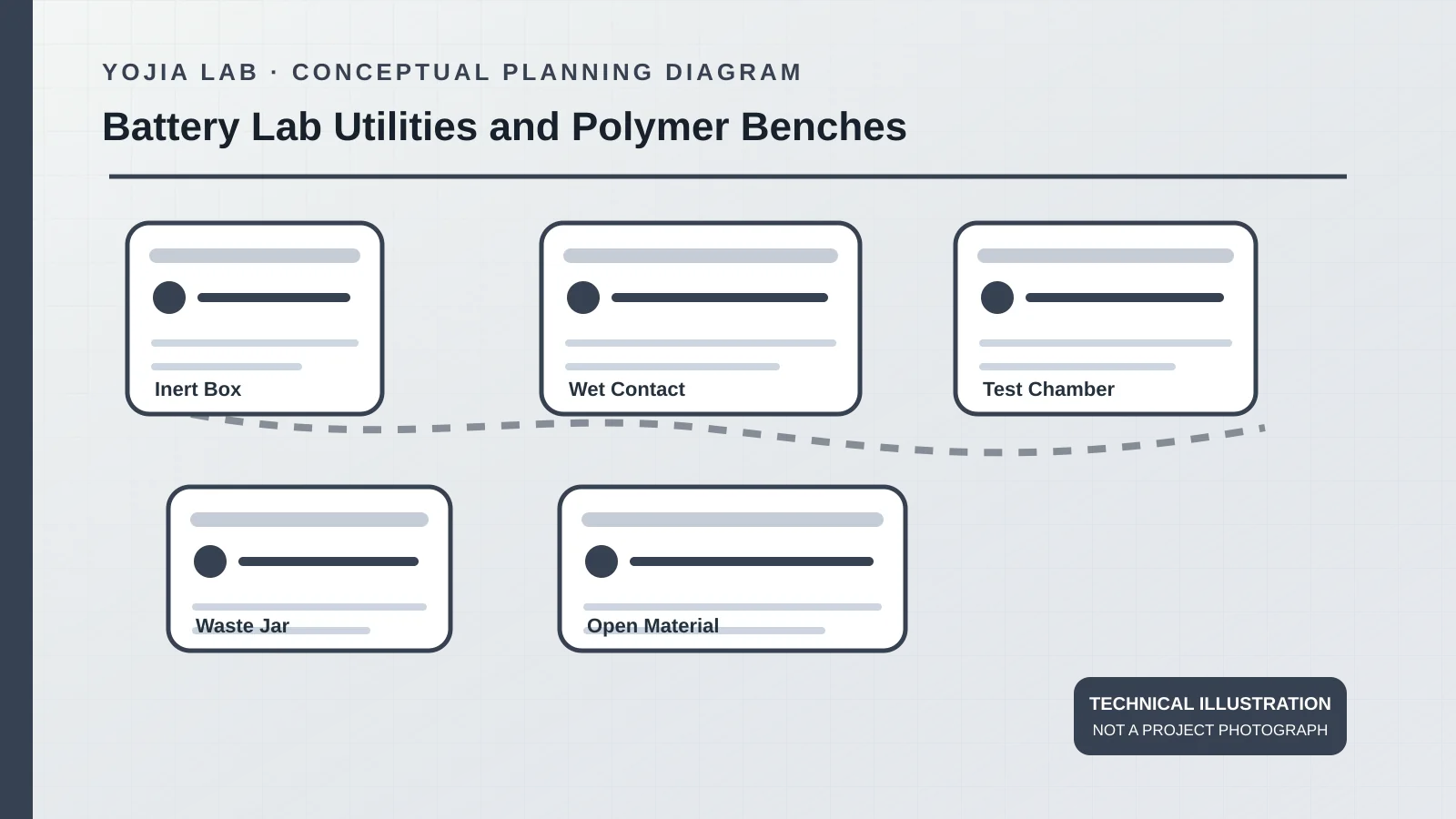
Until those rows exist, leave the bench material blank. The cited facilities show the kind of split to write. They do not rate a surface. The figure marks five planning zones. It is a technical illustration, not a glovebox photograph.
Where the storage duty is considering a polymer cabinet or bench, review polypropylene laboratory furniture on its own. A material name does not show that it fits the chemicals, cleaning method, or fire requirements.