01
Name the storage duties before the material
WHO's current good practices for pharmaceutical quality control laboratories ask for storage organized so samples, retained samples, reagents, laboratory accessories, and reference substances can be kept securely and apart. Conditions that protect stability, including refrigeration at 2–8 °C and frozen storage near −20 °C, are to be controlled, monitored, and recorded, with access limited to designated people. A single run of polypropylene laboratory furniture cannot stand in for that list. The list has to exist before anyone counts doors.
The same guidance allows only small stocks of acids, bases, and solvents in the laboratory, and it calls for separate storage rooms for flammable substances, fuming and concentrated acids and bases, volatile amines, peroxide-forming reagents, and self-igniting materials such as metallic sodium and potassium. Writing PP on a drawing does not create those rooms. The drawing should say which containers are the small stock and which containers are supposed to leave the laboratory suite.
02
Give reference standards a record, not just a shelf
U.S. drug GMP rules require complete records of any testing and standardization of laboratory reference standards, reagents, and standard solutions. They also require laboratory controls to be documented when they are performed, and deviations from written procedures to be recorded and justified. A shelf that mixes a working reagent with a reference standard makes that record harder to keep, because the two items no longer have different homes or different custodians.
For furniture planning, mark the reference-standard location as its own locked volume, name the person who holds the key, and leave space for the register. Controlled or poison-regulated substances, in the WHO text, are marked and kept in locked cabinets under national law, with a designated staff member responsible for the register. Polypropylene or another carcass material is secondary to that lock, that register, and the temperature record. If the duty is only a dry accessory cupboard, say so, and do not borrow the reference-standard rules to justify it.
03
Treat concentrated acids as a room question
National Academies' Prudent Practices advises laboratories to keep incompatible containers apart so a break, a fire, or an emergency response does not mix them, and at minimum to keep fuels away from oxidizers. It also says chemicals should not sit on benchtops except those in current use. A QC room that lines every work surface with bottles is using the surface as a storeroom. The compatibility groups belong in cabinets or in separate rooms, not in a row of open trays under a balance.
The same chapter notes that polypropylene trays can serve as secondary containment for many spills. That sentence is about a tray under a container. It is not a statement that a PP cabinet, a PP bench, or a PP liner is acceptable for every acid on the inventory. Copying the tray sentence into a furniture specification overstates the source. List the compatibility groups the laboratory already uses, and keep the tray, the cabinet, and the remote acid room as three different lines.
04
Ask what the polymer still has to survive
A university environmental health specification for acid cabinets asks for an interior of molded polyethylene or another material that is impervious to acids, manufacturer acceptance for concentrated nitric, sulfuric, or perchloric acid, a one-piece lining, shelves without metal supports, and a raised front lip. Those are one institution's design rules, not a rating published for every polymer product. They are useful because they show the kind of written statement a project may still need.
If the QC laboratory wants to review polypropylene laboratory furniture for a corrosive duty, the package should name the acids, the concentrations, the cleaners, and whether the unit sits in the laboratory or in the separate acid room. A reply can then state the construction offered. Until that reply exists, PP is a candidate material, not a closed specification. Stainless steel furniture can be the comparison for a different duty, such as a dry instrument support, but swapping the metal name for the polymer name does not answer the acid list either.
05
Send the open chemical list with the count
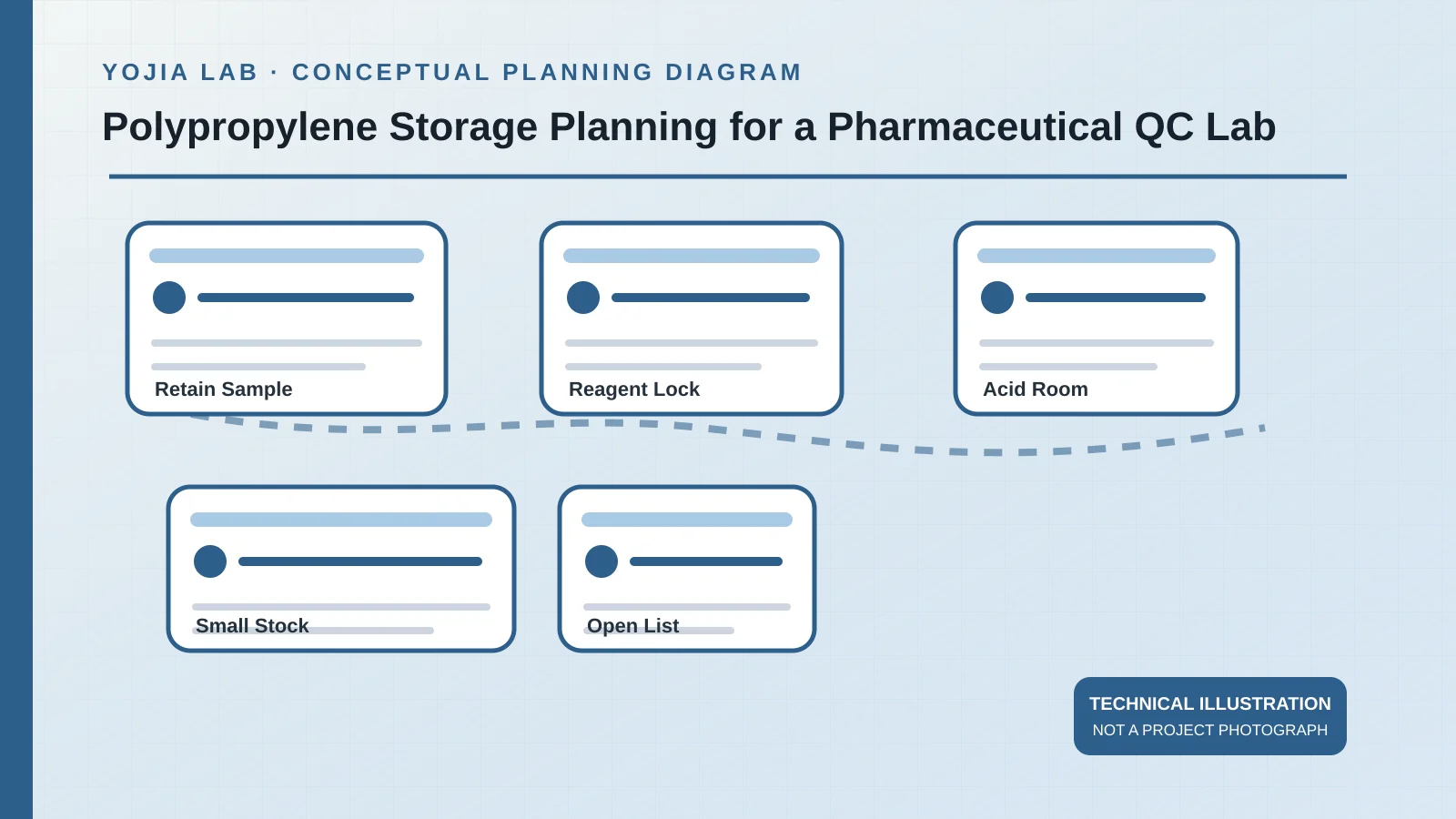
Count cabinets only after the duties are split: retain samples, reference standards, routine reagents, the small in-lab stock, and the remote rooms for flammables and concentrated corrosives. Each count should carry the temperature, the lock, and the maximum the laboratory is willing to put in writing. An empty maximum means the quantity is still unknown, not that the cabinet may be any size.
The package a factory can answer includes those counts, the named chemicals and cleaners, and the blanks. It does not include a claim that the finished room meets WHO good practice, U.S. GMP, or a university cabinet specification. Those judgments stay with the quality unit and the safety reviewers who own the procedures. This article only keeps the polymer question attached to a duty, so the word polypropylene is not left to do the work of the list.
Where the storage duty is considering a polymer cabinet or bench, review polypropylene laboratory furniture on its own. A material name does not show that it fits the chemicals, cleaning method, or fire requirements.