01
The open step is a gram, not a sterilizer
Chapter 23, July 2024, says to examine cosmetic samples as soon as possible and, if they must wait, to store them at room temperature. Do not incubate, refrigerate, or freeze them before or after analysis. Wipe the container with 70 percent ethanol by volume plus 1 percent HCl by volume, or another disinfectant the chapter allows, then dry it with sterile gauze. A laminar-flow hood is used if possible. Products under 1 g or 1 ml are analyzed in full. In the 5 ml example that must also serve other tests, the microbial share is 1 or 2 ml.
A solid is 1 g in a 20 by 150 mm tube holding 1 ml of sterile Tween 80, then 8 ml of modified letheen broth. A cream adds five to seven 5 mm glass beads to that same 1 g and 1 ml. The equipment list asks for sterile plastic petri dishes, 15 by 100 mm, and incubators at 30 ± 2 °C and 35 ± 2 °C. Aerobic plates are inverted for 48 hours at 30 ± 2 °C. An anaerobic control holds MLA plates in air for 2 days at 35 ± 2 °C. The dishes are called plastic, not polypropylene.
02
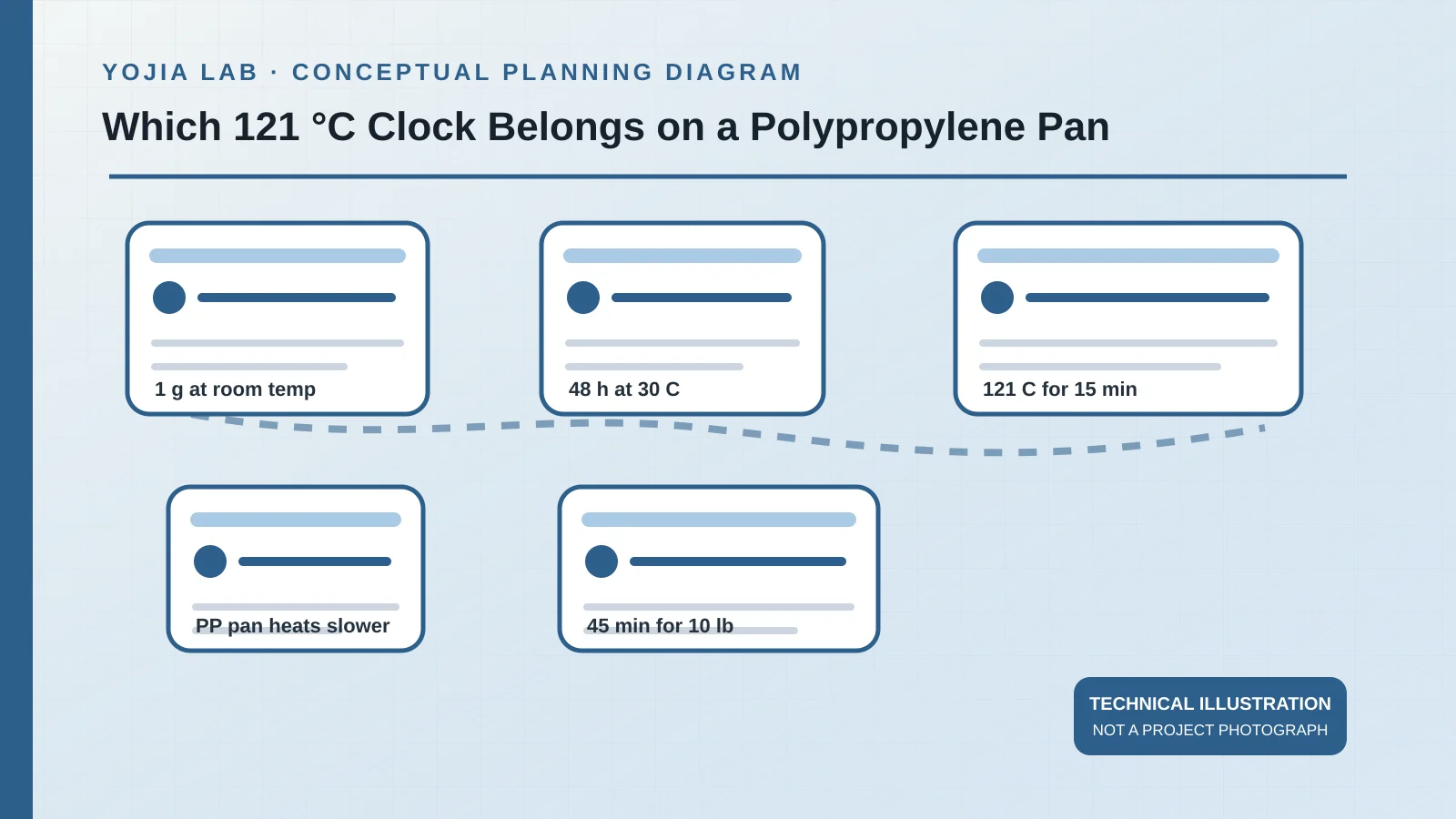
Fifteen minutes at 121 °C is the agar, then a cooler add
Media M93, dated January 2001, dissolves 30 g malt extract and 20 g agar in 1 liter, warns against overheating, and says to autoclave 15 minutes at 121 °C. The general pour is 20 to 25 ml into 15 by 100 mm dishes, with a final pH of 5.5 ± 0.2. The cosmetics paragraph is narrower: cool the medium to 47–50 °C after autoclaving, add filter-sterilized chlortetracycline to 40 ppm, and dispense 20 ml. The 47–50 °C step is there so the antibiotic can be added. It is not a room set-point and not a surface temperature.
That 15-minute clock is one instruction for this medium. It does not say what a waste bag needs, and it does not mention polypropylene. A bench schedule that copies “121 °C” out of M93 has taken the agar cycle and dropped the 15 minutes, the subsequent cool-down, and the 48-hour count at 30 ± 2 °C. Those are three different addresses.
03
The polypropylene sentence is about a pan
The University of Nebraska Medical Center policy IBC01, updated 24 March 2015, applies to people using autoclaves there. In its container section it says polypropylene can withstand autoclaving but resists heat transfer, so a load in a polypropylene pan takes longer than the same load in stainless steel. Polypropylene bags are tear resistant, can puncture, and are impermeable to steam, so they are gathered loosely rather than twisted shut, and they sit in a rigid container. Those sentences are about containers inside the chamber. They do not rate a cabinet standing in the room.
The same policy’s general parameters are 1 hour at 121 °C, printed as 15 lbs, for biohazardous waste; 15 to 20 minutes at 121 °C (15 lbs) for liquids; and 7 minutes at 132 °C (18 lbs) for unwrapped items, which it labels a flash method. A biological-indicator example is described as spores killed by about 15 minutes at 121 °C. The policy also says never to exceed the manufacturer’s recommended pressure and temperature. “15 lbs” stays as printed. This is one university’s operating sheet. It is not the FDA medium, and it is not a specification for PP laboratory furniture.
04
The healthcare guideline uses still other clocks
CDC’s 2008 healthcare guideline names 121 °C (250 °F) and 132 °C (270 °F) as the two common steam temperatures. Wrapped healthcare supplies have a recognized minimum of 30 minutes at 121 °C in a gravity-displacement sterilizer, or 4 minutes at 132 °C in a prevacuum sterilizer. Ten pounds of microbiological waste need at least 45 minutes at 121 °C in a gravity machine, because trapped air slows heating. In that guideline, gravity sterilizers are the machines used for laboratory media, water, pharmaceutical products, regulated medical waste, and nonporous articles steam can touch.
A D-value at 121 °C of 1 to 2 minutes for Geobacillus stearothermophilus is the time to cut that spore count by 90 percent, not a cycle length. The FDA’s 15 minutes, the university’s 1 hour, and the guideline’s 30 or 45 minutes are different duties. PP laboratory furniture still has to be checked against the chemical, the cleaning method, and the fire requirement. A pan that can enter an autoclave does not answer that check, and the open weighing stays at room temperature.
Where the storage duty is considering a polymer cabinet or bench, review PP laboratory furniture on its own. A material name does not show that it fits the chemicals, cleaning method, or fire requirements.